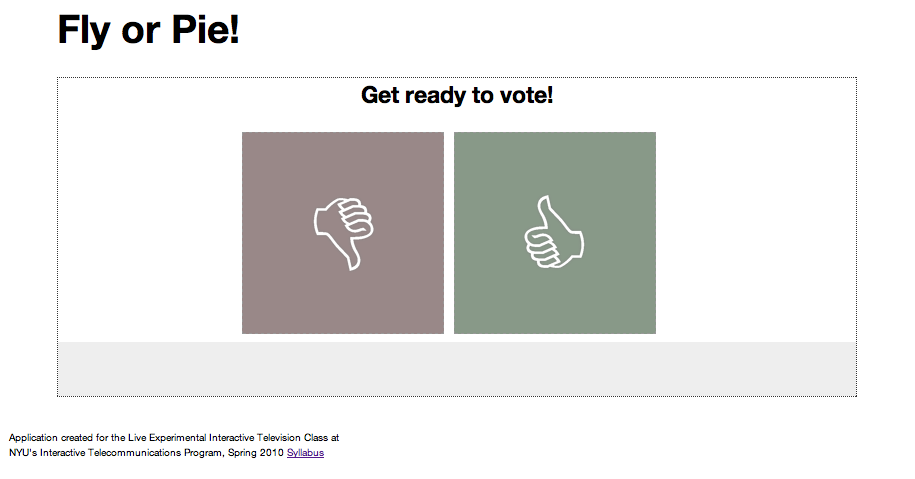
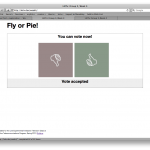
 This assignment was to develop a concept around a two-screen, live event experience; specifically, using TV and computer via internet. Our group’s concept was a variety-style, Gong Show inspired show with binary voting from viewers to determine via aggregate whether a performance was Fly (a rousing success) or Pie (a miserable failure) which received a whipped cream pie in the face. (We’re a classy outfit here..)
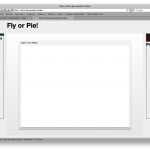
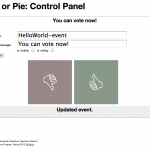
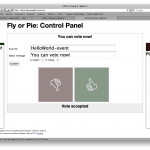
My contribution to the project was the web voting interface and database backend as well as a simple API for communicating with it. I wrote the application using the Sinatra microframework for Ruby and utilized couchrest to communicate with a CouchDB database. A control panel interface enabled an operator to update the voting interface status messages and to open the next event for voting. A display page mocked up the live video with Fly and Pie status bars for viewers to watch.
Although the system is very rudimentary, all the pieces are in place for a live voting situation. During the class demo however, the server was crippled by only a dozen simultaneous connections, and become sluggish enough to be unusable. I believe that the problem stemmed from each of the clients polling the database, and couchrest seems to update a view each time it’s requested. CouchDB is quite fast at reads, but far slower at writes, and I think these things combined to make a big problem.
I think that performance could be greatly enhanced if status polling were eliminated, or at least read from static file that was generated by the control application or server when data needed to be refreshed.
Live voting is a tested and successful model, and the class seemed to enjoy the real-time updates at the beginning while the system was responsive. The show itself was successful largely thanks to Gordie and Lisa Maria’s performances (and willingness to take a pie to their faces from Jong Yoon).
 ]]>
]]>Slashdot users are seeking karma. However, gaining positive karma at Slashdot is just a means to an end; Slashdot users are seeking (limited) power and status among their peers in the form of fleeting moderator access for the vibrant comments component of the highly active, technology-focused news aggregation site. Moderators are chosen from among the registered users using a somewhat obscure algorithm which incorporates each user’s karma rating (a scale of Terrible, Bad, Neutral, Positive, Good, and Excellent), length of membership and randomness. Selected moderators are given special status and 5 mod{eration} points with an expiration window of three days. The moderation status ends when the points have been used in the act of moderating comments or have expired.
The moderation system has been borne out of necessity as the Slashdot community has grown large, bringing the signal-to-noise ratio down and decreasing the satisfaction in reading the raw comment threads. “Flamebait” and “trolls” contribute little more than instigation for starting arguments and fights among the users with typically strong opinions on matters which usually appear on Slashdot. Rob Malda, founder of Slashdot, explains this phenomenon on the Slashdot FAQ:
“One of the unfortunate side-effects of the increasing popularity of Slashdot is that the number of trolls, flame-warriors and all-around lamers increases as well, and it only takes a relatively small number of them to make a lot of noise. Keeping this noise to a minimum is one of the primary goals of the moderation system” (http://slashdot.org/faq/com-mod.shtml#cm500)
Comments are moderated by labeling them as either offtopic, flamebait, troll, redundant, insightful, interesting, informative, funny, overrated or underrated. These adjective labels translate into positive or negative values and are summed to provide the final score. The scoring system for comments is an absolute numeric scale from -1 to 5. Readers can use this scale to filter out comments which have been modded down. While moderators are encouraged to view the comments unfiltered, non-moderators can simply set a viewing threshold which omits the low ranked comments. At times, this creates a disconnect when a highly modded response appears for a hidden comment, however it creates a better overall reading experience (and hidden comments can easily be displayed ad hoc).
Of course, since the moderators are sourced from the same membership pool which is creating the comments to be moderated, controls have been established to limit the influence (or damage) of any one moderator. The small number of mod points provided at a time, short expiration period for them and a somewhat obfuscated moderator selection process make taking advantage of the system by particular users difficult. There is also a metamoderation (m2) system where the larger Slashdot membership can rate the validity of mod points as they have been awarded and can directly influence the karma status of the moderators which awarded them.
Aside from being used to set viewing filters on comment threads, mod points are a direct factor in awarding karma to comment authors. According to the Slashdot FAQ, contributing (good) comments and submitting articles are the primary ways to achieve positive karma, which then increases the chances of being selected as a moderator (for a day, or so). Paraphrased from a story submitted by Slashdot user dkh2: “Post Intelligently, Post Calmly, Post Early, Post Often, Stay On Topic, Be Original, Read It Before You Post, Log In As a Registered User, Read Slashdot Regularly…Come to the party and play.” (http://slashdot.org/faq/com-mod.shtml#cm1900)
In terms of motivators, attaining moderator status provides a sense of all four intrinsic motivators. Being bestowed moderator status confirms a sense of membership in the community, as well as grants a small degree of autonomy. Moderators can recognize competence in other members (as well as affirm their own competence) by modding up particularly good comments, and also display generosity in giving up their limited mod points (although perhaps out of some self-serving drive rather than communal altruism). Modding down poor comments seems similar, but perhaps the generosity is directed toward the community while providing satisfaction at venting ire over undesirable users.
It’s important to note that posting comments is not limited to Slashdot members. “Anonymous cowards” are welcome to post comments on any story. While it seems as though this creates an easy vector to enable trolling and flamebait, the Slashdot chooses to recognize potential utility of anonymous posting:
“We think the ability to post anonymously is important. Sometimes people have important information they want to post, but are afraid to do it if they can be linked to it. Anonymous Coward posting will continue to exist for the foreseeable future.” (http://slashdot.org/faq/com-mod.shtml#cm515)
Anonymous comments begin with zero mod points, so simply adjusting the viewing threshold to 1 and above omits anonymous posts which have not be explicitly modded up and reduces the need for moderators to use up mod points to curtail anonymous flamebait (unless it’s been already modded up for some reason). The stated guidelines for moderators explain Slashdot’s objectives:
“Concentrate more on promoting than on demoting. The real goal here is to find the juicy good stuff and let others read it.…The goal here is to share ideas. To sift through the haystack and find needles. And to keep the children who like to spam Slashdot in check.” (http://slashdot.org/faq/com-mod.shtml#cm600)
While the editors of Slashdot determine which of the submitted stories actually make it to the front page, there has been a conscious decision to keep the commenting system organic. Editors have unlimited moderation points, but comments themselves are not removed. In response to the question “Will you delete my comment?” the resounding answer on the FAQ is:
“No. We believe that discussions in Slashdot are like discussions in real life- you can’t change what you say, you only can attempt to clarify by saying more.…In short, you should think twice before you click that ‘Submit’ button because once you click it, we aren’t going to let you Undo it.” (http://slashdot.org/faq/com-mod.shtml#cm150)
The moderation system has created motivators of its own to keep it self-propagating and self-healing, however the primary motivator among (positive) members of Slashdot is recognition from peers. The tagline for Slashdot is “News for nerds. Stuff that matters.” and there is a real sense that the membership is intelligent, highly competent and well regarded (despite the actual demographics or what can be inferred by the quality of comments). Having a comment deemed as valuable and subsequently modded up provides satisfaction and a sense of accomplishment. There are often choruses of “mod parent up” by non-moderator members imploring peers with moderator status to recognize good comments.
Analysis of larger motivators describing members contributing to a discussion board or comments thread is outside the scope of this examination. However, Slashdot has implemented an interesting self-sustaining system to provide free expression while minimizing inevitable elements which are distracting or possibly damaging to the community. The system is designed to self-moderate and self-select future moderators using recognition of past contributions and actions as indicators of responsibility and competence. A striking element of this system is that lowly moderated comments are not censored but filtered; all contributions are available for viewing by any readers of the site at all times. This is a compelling balance between control and transparency which would be intriguing to experiment with in other contexts.
]]>PLOT/09
– This World & Nearer Ones
Governor’s Island
“Veterans’ Flame” – Krzysztof Wodiczko. The Interactive Flame was the most striking piece for me. Excellent setting, presentation, content. It was quite bare in the ammunition magazine – dark and cool. Listening to accounts of modern conflict/casualties really grounded the experience of being in a historical fort…especially after walking outside it to view the cannons above.
“By My Side” – Susan Philipsz. Singing near Picnic Point. It was moving, but perhaps because I’d already read the description and was looking for it. We missed it the first time we rode a bicycle past the pier. This felt a bit isolated…both in relation to the rest of the sites on the island, but also because the speakers were physically far away from the listening/viewing location.
“Isle of the Dead” – The Bruce High Quality Foundation. (Zombie Theater.) Great incorporation of setting. What was with the zombie chorus of the ENTIRETY of Summer of ’69? The message of the piece was lost on me, and I didn’t find it interesting enough on it’s own as video art.
“Large Dark Wind Chime” – Klaus Weber. Really nice. We saw it on a beautiful, warm, sunny day and the “dark” tones against the serene backdrop was unsettling (but somewhat calming at the same time). It had great scale, much larger than other wind chimes I’ve seen before. The wind vane was at a low enough height that it was manually swing by a woman who had been reading under the tree. I noticed that the ground under the chime has been worn bare; I wonder if the wearing is a symptom of many people doing the same thing.
“Muro Baleado” – Teresa Margolles. Mexican Wall. The physical proof of violence taken out of it’s context and placed into a quiet, grassy field was unnerving when viewed while surrounded by several families picnicking at nearby tables.
With a large, yet contained space such as Governor’s Island, how are projects and sites matched? Some of the projects seemed well matched with their location, while others less so.
I avoided many of the video projects, perhaps unfairly because I didn’t feel a strong connection with them and the location. How does using a historical site place specific constraints on the *appropriateness* of work displayed there? (I mean appropriateness in both a sense of tastefulness and success of execution).
Similarly, the weight of history was palpable while walking around the island. I’ll have to greatly consider the history when thinking of the site for work. More specifically, I’ll have to think of the viewer’s perception of that history and context, rather than my own.
Some of the most successful pieces in the collection were most minimal (Veterans’ Flame). However, too minimal may fail if it doesn’t deliver on the promise of the hype (Double Sound Cannon).
Movable Type
NY Times Lobby
The sound is an important aspect. There is a clicking / shuffling sound reminiscent of teletypes as all the screens are periodically updated simultaneously. Standing in the midst of the installation, with hundreds of screens stretching up and down the lobby, on either side of you, the noise envelopes you.
Text size: some of the screens seems to display headline copy, while others show vertically scrolling body copy.
Macro/micro. It’s nice to step back and feel that the information is washing over you…as if all this real-time data is simply overwhelming. Then step up close to a particular screen and read a story. The switch between wide/shallow and narrow/deep experiences is fun to engage.
Physicality. The screens are small, and relatively lo-tech, but physical. The put out heat, light and (generated) sound. They are suspended by wires and seem to be floating away from the wall. You get a glimpse of the structure of the installation by being able to look behind the screens, but the communication/power is well hidden. It’s a neat paradox of grungy/polished. Large projections would have a much different (lesser) effect.
Bruce Chatwin, “The Songlines”
The writer is researching the concept of a “songline” as integrated in the aboriginal culture. A Songline maps out creation myth as closely tied to the physical landscape. The songs are retained as cultural and intellectual property, and are passed through generations and among clans.
Makes the case that traveling / nomadism has roots or evidence in many cultures the world over.
Does the act of documenting a sacred act or ritual alter it in some way? Specifically, the Songlines need to be passed through generations to be remembered, but that is a deliberately exclusive endeavor.
It interesting to thing of time and location as linked together – ie. Nomads “owning a route” …really means that they have the rights to passage through / to a particular place at a particular time. I would like to explore the time/space element further.
]]>A driving force is a trend or factor, operating in the world today, which will influence the way the future evolves over the next 5-15 years. We were asked to identify a driving force, and it’s associated predetermined elements and critical uncertainties.
Driving Force:
There is a desire for immediate knowledge of trends and events in the physical world.
Predetermined Element:
The physical world will be entirely digitized, and monitored in real-time with a network of sensors. A comprehensive network of various sensors, and software to aggregate and analyze the gathered data will inform wide-ranging areas. These sensors may be built into other devices, such as mobile handsets and vehicles or may be standalone. Sensors need not only be inanimate; sentient beings may gather and provide rich sets of data.
Critical Uncertainty:
Rate of technological evolution for inexpensive, low/self-powered sensors. Also, the time frame of deployment of these sensors once available. Proliferation of ubiquitous wireless network access to enable constant connectivity with the sensors. Contingent on public acceptance of near-constant reporting of data.
About 30 seconds.
Laundromat.
4:28
Using dryer
Operating machine. Slipping a plastic card into slot on machine. Repeatedly.
Waited for a few momnts, then moved to try a machine a few down the row.
Apparently trying to pay for machine.
1 person.
Hands, Holding card. Sight, look a slot and line up card. Arm, to lift card and insert.
Laundromat. Driggs at Metropolitan
Change machine.
4:25
Looking to convert paper money to coinage.
1 person using the machine, one person waiting.
Touching, finger. Standing at the machine. Looking at the button selections. Entering the paper money into the machine. Waiting for the change.
]]>Coffee shop. Havemeyer at grand
4:36
Reading, typing, listening, mostly on computers-laptops.
Some alone. Some with other people.
(heard an AOL “you’ve got mail” announcement)
Maybe 20 people total in the shop.
Those in pairs are talking despite using the computer at the same time
Those alone seem to be quiet and staring intently at the computer screen.
Some seem to be engaged for a long time, 15 minutes it more. Others seem to be getting specific tasks done and putting the computer aside.
Some pairs are showing each other thugs on their screens.
Hands typing. Looking at screens. Talking with each other. Sitting. Able to take some time since they are sitting and eating/drinking.
Can pick up and move the computer. One woman took it with her from the table to the counter. One pair of women switch seamlessly between English and german. The barista switches from Italian to english.
Of the assignment description, the final sentences drew my attention:
“How would you explain it to someone who’s deaf. What is purpose of visualizing sound differently? Could you think of it as drawing with your voice?”
I happened to be sitting on Astor eating a sandwich after class and started thinking about these things. My initial notes:
Sound is time based…display the history (as a line, etc.)? Only show the immediate samples?
Sound is also layered and it is spatial. Think of a city street. There are sounds in all directions and distances. Is it the amplitude (volume) which is a clue to distance, or is it something like parallax?
Properties of digital sound: frequency, amplitude, sample rate, sample size, channels (stereo)
—
As a drawing tool: sound volume is really changes in pressure. An airbrush or paintbrush change the thickness of their strokes based on pressure. Can the drawing tool use sound amplitude in place of physical pressure?How about opacity? Use the same technique? Have to hum lightly to make any mark at all?
What about color? Map a range of frequencies to a spectrum of color? Human voice, piano, etc? This is less useful in a noisy environment with many overlapping sounds.
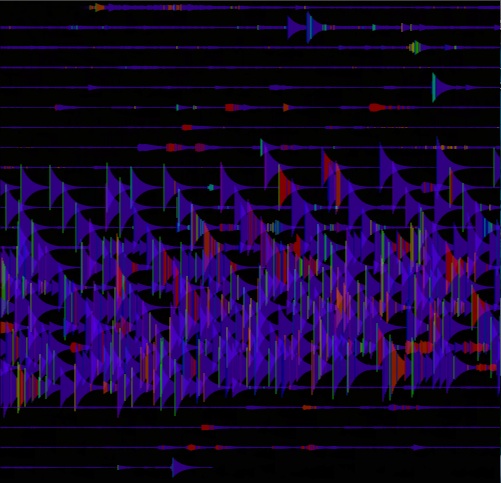
I have started to create a drawing tool, but in the iterative process I have gone to a representation of the microphone’s sound in horizontal rows. Amplitude determines the height of each vertical line, the pitch of the loudest sample determines the hue. I have an alternate version using opacity to represent pitch. There’s much more experimentation to do.
]]>