<?xml version="1.0" encoding="UTF-8"?>
<rss version="2.0"
	xmlns:content="http://purl.org/rss/1.0/modules/content/"
	xmlns:wfw="http://wellformedweb.org/CommentAPI/"
	xmlns:dc="http://purl.org/dc/elements/1.1/"
	xmlns:atom="http://www.w3.org/2005/Atom"
	xmlns:sy="http://purl.org/rss/1.0/modules/syndication/"
	xmlns:slash="http://purl.org/rss/1.0/modules/slash/"
	>

<channel>
	<title>exploration &#187; make</title>
	<atom:link href="http://robertcarlsen.net/tag/make/feed" rel="self" type="application/rss+xml" />
	<link>http://robertcarlsen.net</link>
	<description>accounts of success and misadventure</description>
	<lastBuildDate>Tue, 13 Jul 2010 14:37:06 +0000</lastBuildDate>
	<generator>http://wordpress.org/?v=2.8.4</generator>
	<language>en</language>
	<sy:updatePeriod>hourly</sy:updatePeriod>
	<sy:updateFrequency>1</sy:updateFrequency>
			<item>
		<title>ITP 1-in-1: bike blinky!</title>
		<link>http://robertcarlsen.net/2009/10/04/itp-1-in-1-bike-blinky-975</link>
		<comments>http://robertcarlsen.net/2009/10/04/itp-1-in-1-bike-blinky-975#comments</comments>
		<pubDate>Sun, 04 Oct 2009 16:07:10 +0000</pubDate>
		<dc:creator>Robert</dc:creator>
				<category><![CDATA[itp]]></category>
		<category><![CDATA[1in1]]></category>
		<category><![CDATA[arduino]]></category>
		<category><![CDATA[bike]]></category>
		<category><![CDATA[blinky]]></category>
		<category><![CDATA[itp30]]></category>
		<category><![CDATA[led]]></category>
		<category><![CDATA[make]]></category>
		<category><![CDATA[project]]></category>
		<category><![CDATA[tail light]]></category>

		<guid isPermaLink="false">http://robertcarlsen.net/?p=975</guid>
		<description><![CDATA[For the 1-in-1 Project as part of ITP&#8217;s 30th anniversary celebration I over-engineering the simple bicycle blinky light. Why go for a simple, off-the-shelf blinky light when we can build a much more complicated one ourselves?!
I’m creating an animated display, which changes to solid red while braking.
Update: (5:26) It’s been a long night, but it [...]]]></description>
			<content:encoded><![CDATA[<p><a href="http://robertcarlsen.net/blog/wp-content/uploads/2009/10/blinky_on_bike.png" rel="lightbox[975]"><img class="alignright size-thumbnail wp-image-976" title="blinky_on_bike" src="http://robertcarlsen.net/blog/wp-content/uploads/2009/10/blinky_on_bike-150x150.png" alt="blinky_on_bike" width="150" height="150" /></a>For the 1-in-1 Project as part of ITP&#8217;s 30th anniversary celebration I over-engineering the simple bicycle blinky light. Why go for a simple, off-the-shelf blinky light when we can build a much more complicated one ourselves?!</p>
<p>I’m creating an animated display, which changes to solid red while braking.</p>
<p>Update: (5:26) It’s been a long night, but it all came together. I wish I could have finished at the floor, but sometimes you need to go to your cave. The bike blinky light is all I could have asked for…it’s obnoxious, it’s animated, it has a handlebar control to switch to a flashing warning mode.<span id="more-975"></span></p>
<p>Context:<br />
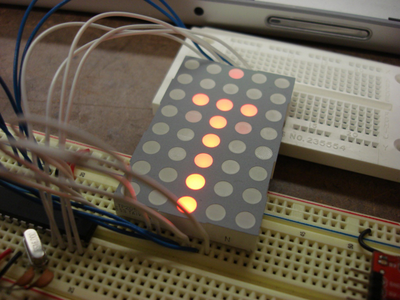
<a href="http://robertcarlsen.net/blog/wp-content/uploads/2009/10/breadboard_matrix.png" rel="lightbox[975]"><img class="alignright size-thumbnail wp-image-977" title="breadboard_matrix" src="http://robertcarlsen.net/blog/wp-content/uploads/2009/10/breadboard_matrix-150x150.png" alt="breadboard_matrix" width="150" height="150" /></a>I got a package of several 5×8 LED matrix displays early in my first semester on clearance from an online electronics wholesaler. I’ve had aspirations to work them into a project ever since but never got around to it.</p>
<p>Several months ago my bicycle taillight stopped working. I took it apart and found a bad solder joint at the LED, so I fixed it and it was happy for several more weeks before acting up again. Now, I’m betting that it’s just a dead battery, but those coin cells can be expensive!</p>
<p>A (more) reasonable person would just get new batteries…performing an effective mental calculation between cost and safety. I say that’s a fool’s errand! Just build a new one, with a rechargeable lithium battery…and while you’re at it upgrade from one LED to 40!</p>
<p><a href="http://robertcarlsen.net/blog/wp-content/uploads/2009/10/matrix_blinky.png" rel="lightbox[975]"><img class="alignright size-thumbnail wp-image-978" title="matrix_blinky" src="http://robertcarlsen.net/blog/wp-content/uploads/2009/10/matrix_blinky-150x150.png" alt="matrix_blinky" width="150" height="150" /></a>I suppose this is from the “because we can” category. Next steps are to build a weatherproof housing, quick-release mounting, serial control for updating the animation and maybe generative graphics or bluetooth…real-time Twitter feed anyone?</p>
<p>Check out the other <a href="http://www.itp30show.org/" onclick="pageTracker._trackPageview('/outgoing/www.itp30show.org/?referer=');">ITP30 1-in-1</a> projects.</p>
<p><object width="425" height="344"><param name="movie" value="http://www.youtube.com/v/ukhcfbjP7J4&#038;fs=1" /><param name="allowFullScreen" value="true" /><param name="allowscriptaccess" value="always" /><embed src="http://www.youtube.com/v/ukhcfbjP7J4&#038;fs=1" type="application/x-shockwave-flash" allowscriptaccess="always" allowfullscreen="true" width="425" height="344"></embed></object></p>
]]></content:encoded>
			<wfw:commentRss>http://robertcarlsen.net/2009/10/04/itp-1-in-1-bike-blinky-975/feed</wfw:commentRss>
		<slash:comments>2</slash:comments>
		</item>
		<item>
		<title>Thinking Physically: ThinkBig</title>
		<link>http://robertcarlsen.net/2009/03/13/thinking-physically-thinkbig-564</link>
		<comments>http://robertcarlsen.net/2009/03/13/thinking-physically-thinkbig-564#comments</comments>
		<pubDate>Sat, 14 Mar 2009 00:51:00 +0000</pubDate>
		<dc:creator>Robert</dc:creator>
				<category><![CDATA[Thinking Physically]]></category>
		<category><![CDATA[itp]]></category>
		<category><![CDATA[arduino]]></category>
		<category><![CDATA[make]]></category>
		<category><![CDATA[think phys]]></category>
		<category><![CDATA[wearable]]></category>

		<guid isPermaLink="false">http://robertcarlsen.net/blog/?p=564</guid>
		<description><![CDATA[
Corey Menscher and I worked together on ThinkBig for the Whole Body Interface exercise in Thinking Physically. Corey had the basic idea of making soft switches which would be foot activated. Initially he was going to make three which you&#8217;d have to skip between.
We had a discussion about other implementations of the idea, including a [...]]]></description>
			<content:encoded><![CDATA[<p><img class="alignright size-thumbnail wp-image-566" title="thinkbig-floor" src="http://robertcarlsen.net/blog/wp-content/uploads/2009/03/thinkbig-floor-150x150.jpg" alt="thinkbig-floor" width="150" height="150" /></p>
<p>Corey Menscher and I worked together on ThinkBig for the Whole Body Interface exercise in Thinking Physically. Corey had the basic idea of making soft switches which would be foot activated. Initially he was going to make three which you&#8217;d have to skip between.<span id="more-564"></span></p>
<p>We had a discussion about other implementations of the idea, including a hopscotch-type arrangement but ended up riffing off the large keyboard depicted at FAO Schwartz in the movie Big. To this end we made 8 switches which would be mapped to notes on a musical scale. After more discussion we decided to allow the switches to be arbitrarily positioned, including on walls, and the actions would trigger sound samples rather than notes.</p>
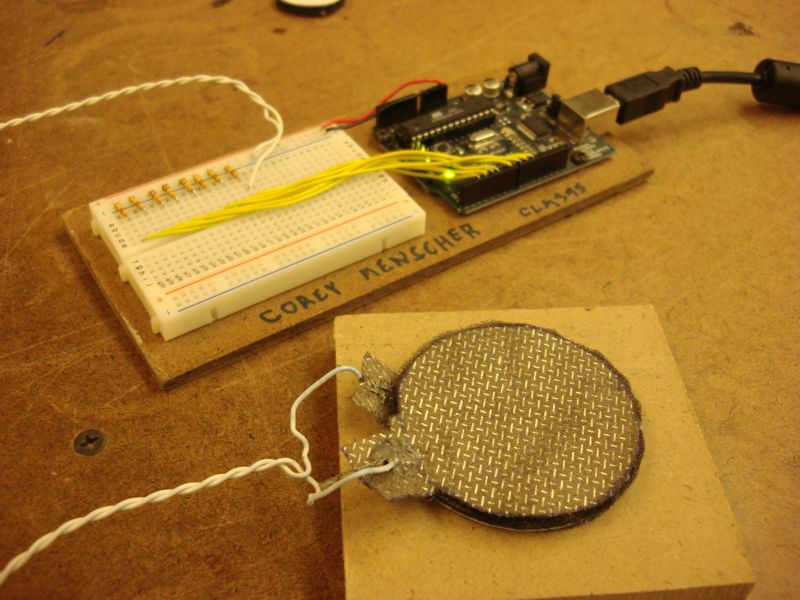
<p><a href="http://robertcarlsen.net/blog/wp-content/uploads/2009/03/thinkbig-guts.jpg" rel="lightbox[564]"><img class="alignleft size-thumbnail wp-image-567" style="margin-right: 2px;" title="thinkbig-guts" src="http://robertcarlsen.net/blog/wp-content/uploads/2009/03/thinkbig-guts-150x150.jpg" alt="thinkbig-guts" width="150" height="150" /></a>Building the soft switches was easy enough – two layers of conductive fabric with a layer of dense foam between them. We wanted to put them on flexible surfaces, but for the prototype affixed each to a small wooden block.</p>
<p>The class seemed to enjoy using them, especially when they were on the wall rather than the floor. The scale of the interface encouraged multiple simultaneous users to play, and the distance between each switch introduced a natural limit to how quickly you could move from one switch to the next. As with the Brauswitch the output was simple sound samples, but it would be interesting to experiment with other actions.</p>
<p>Video of the class trying it out below. Enjoy.</p>
<p><object width="425" height="344"><param name="movie" value="http://www.youtube.com/v/Dq-EwkHjtMU&#038;fs=1" /><param name="allowFullScreen" value="true" /><param name="allowscriptaccess" value="always" /><embed src="http://www.youtube.com/v/Dq-EwkHjtMU&#038;fs=1" type="application/x-shockwave-flash" allowscriptaccess="always" allowfullscreen="true" width="425" height="344"></embed></object></p>
]]></content:encoded>
			<wfw:commentRss>http://robertcarlsen.net/2009/03/13/thinking-physically-thinkbig-564/feed</wfw:commentRss>
		<slash:comments>0</slash:comments>
		</item>
		<item>
		<title>Spatial Media: TrafficFlow update</title>
		<link>http://robertcarlsen.net/2009/03/05/spatial-media-trafficflow-update-543</link>
		<comments>http://robertcarlsen.net/2009/03/05/spatial-media-trafficflow-update-543#comments</comments>
		<pubDate>Thu, 05 Mar 2009 08:34:41 +0000</pubDate>
		<dc:creator>Robert</dc:creator>
				<category><![CDATA[Spatial Media]]></category>
		<category><![CDATA[itp]]></category>
		<category><![CDATA[make]]></category>
		<category><![CDATA[openframeworks]]></category>
		<category><![CDATA[processing]]></category>
		<category><![CDATA[programming]]></category>
		<category><![CDATA[tangible]]></category>

		<guid isPermaLink="false">http://robertcarlsen.net/blog/?p=543</guid>
		<description><![CDATA[Simple updates on the project. The previz applet has mouse control for each of the emitters. It&#8217;s interesting to see how the glowing packets influence each other when in close proximity. Here&#8217;s the applet.

Camera vision. Started working with openFrameworks to do the visual tracking of objects on the table. Unexposed portions of developed film negatives [...]]]></description>
			<content:encoded><![CDATA[<p>Simple updates on the project. The previz applet has mouse control for each of the emitters. It&#8217;s interesting to see how the glowing packets influence each other when in close proximity. Here&#8217;s the <a href="http://robertcarlsen.net/experiments/spatialMedia/flow_demo_v1.2/">applet</a>.</p>
<p><a href="http://robertcarlsen.net/blog/wp-content/uploads/2009/03/ir_flame.jpg" rel="lightbox[543]"><img class="alignright size-thumbnail wp-image-544" title="ir_flame" src="http://robertcarlsen.net/blog/wp-content/uploads/2009/03/ir_flame-150x150.jpg" alt="ir_flame" width="150" height="150" /></a></p>
<p>Camera vision. Started working with openFrameworks to do the visual tracking of objects on the table. Unexposed portions of developed film negatives block most visible light and let IR light pass. Using this as a filter over the built-in iSight camera, I was able to test a rudimentary camera tracking system. It would likely be better to use a more robust library like openCV, but writing the tracking myself helped me to learn about how it works.</p>
<p>Still have to merge these two components. It looks like I&#8217;ll have to rewrite the flocking system in C++ since Processing/Java is getting bogged down. Ameya is working on the web side of the project – messing with a linux-based router to handle the proxy and packet sniffing as well as a database system to manage the data.</p>
<p>The table was built throughout this past week; we still need to mount the camera and projector in an effective way for under projection and sensing&#8230;any advice?</p>
]]></content:encoded>
			<wfw:commentRss>http://robertcarlsen.net/2009/03/05/spatial-media-trafficflow-update-543/feed</wfw:commentRss>
		<slash:comments>0</slash:comments>
		</item>
		<item>
		<title>Thinking Physically: brauswitch demonstration</title>
		<link>http://robertcarlsen.net/2009/02/21/thinking-physically-brauswitch-demonstration-500</link>
		<comments>http://robertcarlsen.net/2009/02/21/thinking-physically-brauswitch-demonstration-500#comments</comments>
		<pubDate>Sat, 21 Feb 2009 20:48:30 +0000</pubDate>
		<dc:creator>Robert</dc:creator>
				<category><![CDATA[Thinking Physically]]></category>
		<category><![CDATA[Uncategorized]]></category>
		<category><![CDATA[arduino]]></category>
		<category><![CDATA[itp]]></category>
		<category><![CDATA[java]]></category>
		<category><![CDATA[make]]></category>
		<category><![CDATA[processing]]></category>
		<category><![CDATA[programming]]></category>
		<category><![CDATA[think phys]]></category>
		<category><![CDATA[video]]></category>
		<category><![CDATA[wearable]]></category>

		<guid isPermaLink="false">http://robertcarlsen.net/blog/?p=500</guid>
		<description><![CDATA[Following up on the initial post about the brauswitch &#8211; the eyebrow activated headband switch. Here is some video with a simple application demonstrating it&#8217;s use. There are separate switches for both the left and right sides. The simple Arduino code listed below will indicate if the left, right or both sides have been activated. [...]]]></description>
			<content:encoded><![CDATA[<p><a href="http://robertcarlsen.net/blog/wp-content/uploads/2009/02/kara_brauswitch.jpg" rel="lightbox[500]"><img class="alignright size-thumbnail wp-image-501" title="kara_brauswitch" src="http://robertcarlsen.net/blog/wp-content/uploads/2009/02/kara_brauswitch-150x150.jpg" alt="kara_brauswitch" width="150" height="150" /></a>Following up on the initial post about the <a href="http://robertcarlsen.net/blog/?p=430">brauswitch</a> &#8211; the eyebrow activated headband switch. Here is some video with a simple application demonstrating it&#8217;s use. There are separate switches for both the left and right sides. The simple Arduino code listed below will indicate if the left, right or both sides have been activated. A Processing sketch reads the serial output of the device and plays a variety of sound samples.</p>
<p>There is something really nice about the amplification of a small facial movement and the larger audio/visual response of the sketch. It&#8217;s also nice to interact in a handsfree way. Oh! Fun. Code after the video.<span id="more-500"></span></p>
<p><object width="425" height="344"><param name="movie" value="http://www.youtube.com/v/XQSk12AwXnY&#038;fs=1" /><param name="allowFullScreen" value="true" /><param name="allowscriptaccess" value="always" /><embed src="http://www.youtube.com/v/XQSk12AwXnY&#038;fs=1" type="application/x-shockwave-flash" allowscriptaccess="always" allowfullscreen="true" width="425" height="344"></embed></object></p>
<p><strong>Arduino code:</strong></p>
<pre class="brush: cpp;">

/* brauswitch
* robert carlsen | robertcarlsen.net
* 2-2008
*
* the brauswitch is a headband mounted switch activated by raising the eyebrows.
* the prototype version is made from burlap with conductive fabric on opposite sides
* of a small gap in the headband just above the eyebrows. raising the eyebrows closes the gap
* which closes the switch. the position of the headband needs to be adjusted carefully for proper
* action - however once situated well the brauswitch works very consistently.
*
* this code sends a byte via serial when the switch is closed:
* 1, 2 or 3 for left, right and both switches respectively
*/

#define LEFT_BROW 8
#define RIGHT_BROW 9
#define LED 3

void setup() {
Serial.begin(9600);

pinMode(LEFT_BROW, INPUT);
pinMode(RIGHT_BROW, INPUT);
pinMode(LED, OUTPUT);

}

void loop(){
int var1 = digitalRead(LEFT_BROW);
int var2 = digitalRead(RIGHT_BROW);

byte msg = 0;

if(var1 == HIGH){
digitalWrite(LED, HIGH);
msg += 1;
delay(10);
digitalWrite(LED, LOW);
}

if(var2 == HIGH){
digitalWrite(LED, HIGH);
msg += 2;
delay(100);
digitalWrite(LED, LOW);
}

if(msg&gt;0)
Serial.print(msg,BYTE);

delay(100);
}
</pre>
<p><strong>Processing (java) code:</strong></p>
<pre class="brush: java;">

// Project:         brauswitch
// File:             Brauswitch.java
// Created by:         rcarlsen, Feb 21, 2009

// Imports
import processing.core.*;
import ddf.minim.*;
import processing.serial.*;

public class Brauswitch extends PApplet {
Serial myPort;

// holder for the incoming data
byte[] data = new byte[1];

// color array
int[] c = {0x33000000,0x33ff0000,0x3300ff00,0x330000ff};
int cIndex = 0;

int timer;
int timeout = 1000;

Minim minim;
AudioSnippet bothSound,leftSound,rightSound;

public void setup() {
size(500,300);
smooth();
background(0);
noStroke();

//println(Serial.list());
myPort = new Serial(this,Serial.list()[0],9600);

minim = new Minim(this);
bothSound = minim.loadSnippet(&quot;beat.wav&quot;);
leftSound = minim.loadSnippet(&quot;msgstart.wav&quot;);
rightSound = minim.loadSnippet(&quot;msgend.wav&quot;);
}

public void draw() {
// draw a partially transparent rect over the previous frame
fill(0x33000000);
rect(0,0,width,height);

// read the serial data is available
if(myPort.available()&gt;0){
println(myPort.available() + &quot; bytes available&quot;);

//only expecting one byte
data = myPort.readBytes();
myPort.clear();
}

// act on the read data. it will be 0,1,2,3
if(data[0]&gt;0){
println(&quot;Data read: &quot; + data[0]);
cIndex = data[0];
// clear the data
data[0] = 0;

switch(cIndex){
case 1:
if(!leftSound.isPlaying())
leftSound.loop(0);
break;
case 2:
if(!rightSound.isPlaying())
rightSound.loop(0);
break;
case 3:
if(!bothSound.isPlaying())
bothSound.loop(0);
break;
}

// keep the timer going
timer = millis();
}

// fade out if the brauswitch is open
if(millis() - timer &gt; timeout){
cIndex = 0;
if(bothSound.isLooping())
bothSound.play(); //finish the sound and stop
if(leftSound.isPlaying())
leftSound.pause();
if(rightSound.isPlaying())
rightSound.pause();
timer = millis();
}

// draw the indicator ellipse
fill(c[cIndex]);
ellipseMode(CENTER);
ellipse(this.width/2, this.height/2,200,200);
}

public void stop()
{
// always close Minim audio classes
bothSound.close();
leftSound.close();
rightSound.close();
// always stop Minim before exiting
minim.stop();

super.stop();
}
}
</pre>
]]></content:encoded>
			<wfw:commentRss>http://robertcarlsen.net/2009/02/21/thinking-physically-brauswitch-demonstration-500/feed</wfw:commentRss>
		<slash:comments>0</slash:comments>
		</item>
		<item>
		<title>feeling productive&#8230;iPhone glove</title>
		<link>http://robertcarlsen.net/2009/02/19/feeling-productiveiphone-glove-492</link>
		<comments>http://robertcarlsen.net/2009/02/19/feeling-productiveiphone-glove-492#comments</comments>
		<pubDate>Thu, 19 Feb 2009 23:21:54 +0000</pubDate>
		<dc:creator>Robert</dc:creator>
				<category><![CDATA[make]]></category>
		<category><![CDATA[fun]]></category>
		<category><![CDATA[gloves]]></category>
		<category><![CDATA[sewing]]></category>
		<category><![CDATA[wearable]]></category>

		<guid isPermaLink="false">http://robertcarlsen.net/blog/?p=492</guid>
		<description><![CDATA[after another rough week of classes, planning and discussions about projects without actually making anything, i needed a quick productivity break. iPhone gloves.
some quick background. the touchscreen on the iPhone and iPod Touch (as well as the older click wheel iPods and trackpad on Macbook/Pro&#8217;s) use the capacitance of skin to track touches. gloves generally [...]]]></description>
			<content:encoded><![CDATA[<p>after another rough week of classes, planning and discussions about projects without actually making anything, i needed a quick productivity break. iPhone gloves.</p>
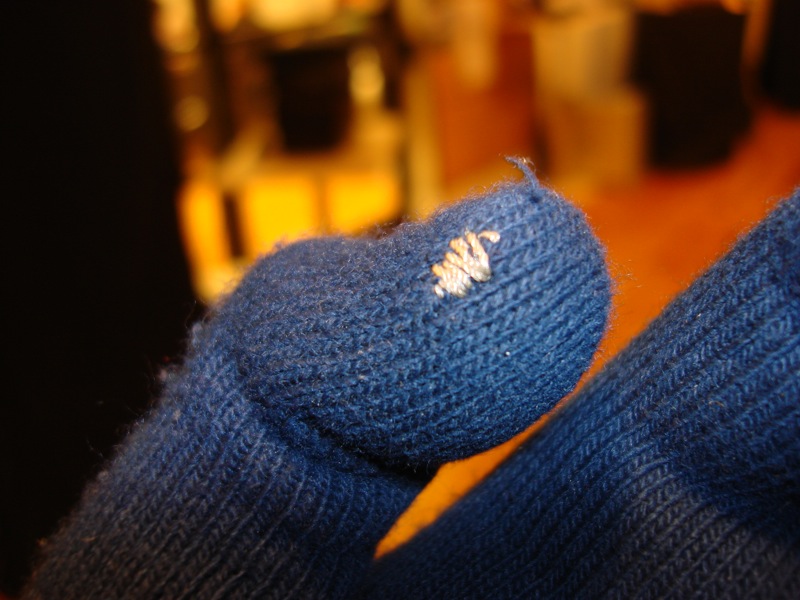
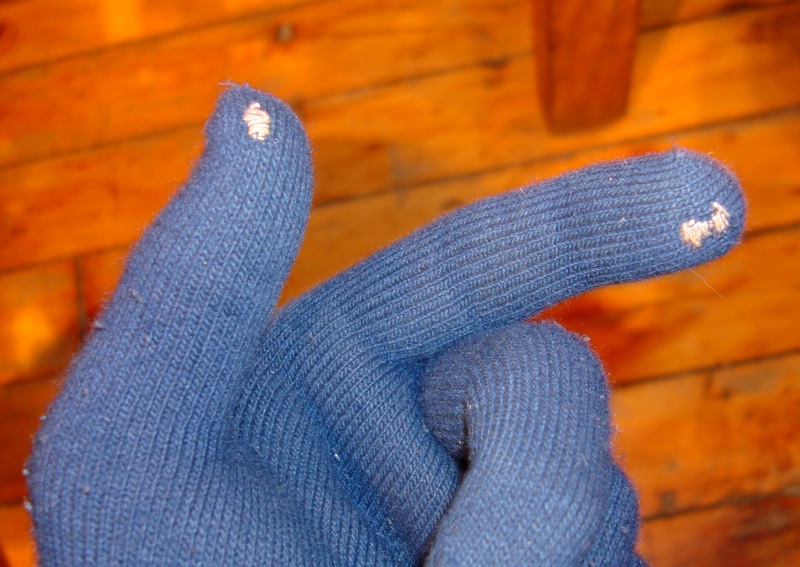
<p><a href="http://robertcarlsen.net/blog/wp-content/uploads/2009/02/dsc03409.jpg" rel="lightbox[492]"><img class="alignright size-thumbnail wp-image-493" title="dsc03409" src="http://robertcarlsen.net/blog/wp-content/uploads/2009/02/dsc03409-150x150.jpg" alt="dsc03409" width="150" height="150" /></a>some quick background. the touchscreen on the iPhone and iPod Touch (as well as the older click wheel iPods and trackpad on Macbook/Pro&#8217;s) use the capacitance of skin to track touches. gloves generally prevent these type of sensors from reading (except perhaps very thin gloves). taking off a glove to use the phone is frustrating, especially when trying to momentarily check something that would only take a few seconds (text messages, e-mails, etc).<span id="more-492"></span></p>
<p><a href="http://robertcarlsen.net/blog/wp-content/uploads/2009/02/dsc03407.jpg" rel="lightbox[492]"><img class="alignleft size-thumbnail wp-image-494" style="margin-right: 2px;" title="dsc03407" src="http://robertcarlsen.net/blog/wp-content/uploads/2009/02/dsc03407-150x150.jpg" alt="dsc03407" width="150" height="150" /></a>there are gloves currently available which work in a variety of ways, but i already have gloves which i use &#8211; specifically glove liners that i wear under my flip-back mittens when riding a bike in the cold. (of course, i&#8217;m not advocating using the device while riding, but it&#8217;s nice to check an incoming message while waiting at a traffic light).</p>
<p>the solution i used was to sew two pads of conductive thread into the tips of the forefinger and thumb. they are simple, knit polypropylene  gloves from performance bike but any material would likely work just the same. the thread goes through the cloth and touches the skin of the fingers inside the glove. anyway, they work as expected &#8211; super convenient.</p>
<p><object width="425" height="344"><param name="movie" value="http://www.youtube.com/v/e1fIy490oLg&#038;fs=1" /><param name="allowFullScreen" value="true" /><param name="allowscriptaccess" value="always" /><embed src="http://www.youtube.com/v/e1fIy490oLg&#038;fs=1" type="application/x-shockwave-flash" allowscriptaccess="always" allowfullscreen="true" width="425" height="344"></embed></object></p>
]]></content:encoded>
			<wfw:commentRss>http://robertcarlsen.net/2009/02/19/feeling-productiveiphone-glove-492/feed</wfw:commentRss>
		<slash:comments>3</slash:comments>
		</item>
		<item>
		<title>Toy Design: TraceBug proposal</title>
		<link>http://robertcarlsen.net/2009/02/17/toy-design-tracebug-proposal-468</link>
		<comments>http://robertcarlsen.net/2009/02/17/toy-design-tracebug-proposal-468#comments</comments>
		<pubDate>Tue, 17 Feb 2009 19:53:59 +0000</pubDate>
		<dc:creator>Robert</dc:creator>
				<category><![CDATA[Toy Design]]></category>
		<category><![CDATA[car]]></category>
		<category><![CDATA[itp]]></category>
		<category><![CDATA[make]]></category>
		<category><![CDATA[processing]]></category>
		<category><![CDATA[robot]]></category>
		<category><![CDATA[toy fair]]></category>

		<guid isPermaLink="false">http://robertcarlsen.net/blog/?p=468</guid>
		<description><![CDATA[Visiting the American International Toy Fair gave me a brief overview of what is popular across many facets of the toy industry. I wouldn&#8217;t claim to have a thorough comprehension of the market, but it was certainly an informative experience.
Some of my notes from fair:
Infrared control.
Lots of robot kits. Solar powered vs. battery powered.
Grouped into [...]]]></description>
			<content:encoded><![CDATA[<p><a href="http://robertcarlsen.net/blog/wp-content/uploads/2009/02/tracebug.jpg" rel="lightbox[468]"><img class="alignright size-thumbnail wp-image-471" title="tracebug" src="http://robertcarlsen.net/blog/wp-content/uploads/2009/02/tracebug-150x150.jpg" alt="tracebug" width="150" height="150" /></a>Visiting the American International Toy Fair gave me a brief overview of what is popular across many facets of the toy industry. I wouldn&#8217;t claim to have a thorough comprehension of the market, but it was certainly an informative experience.</p>
<p><strong>Some of my notes from fair:</strong><br />
Infrared control.<br />
Lots of robot kits. Solar powered vs. battery powered.<br />
Grouped into prefab and modular kits.<br />
Sound and light sensors, too.<br />
Example: HexPods. Overheard vendor discuss user testing: Kids want control and speed.<br />
Slot car systems. Even here there is much licensing. (Nintendo &#8211; Mario Cart)<br />
Figurine playsets. Thematically related. Realistically detailed.  Schleich.<br />
Glow strings and kits.<br />
Materials: Lots of plastic (PVC), lots of wood.<br />
Many stuffed animals.<br />
Lots of board games and educational toys. Brain teasers.<br />
Flying toys. Planes/helicopters.<br />
Tents and other enclosures.<br />
Saw remote controlled drawing robots. Reminded me of Chris Cerrito&#8217;s project<br />
Pedal powered cart. Awesome. Disc brakes and 7 speed shifting.<span id="more-468"></span></p>
<p><strong>So, an idea for the toy design class:</strong><br />
Handheld car/wheeled bot. Move it around, let go of it, then it will continually mimic the previous movement. Inspired by <a href="http://www.flong.com/storage/experience/yellowtail/" onclick="pageTracker._trackPageview('/outgoing/www.flong.com/storage/experience/yellowtail/?referer=');">yellowtail</a>, but physical. I feel that I&#8217;ve seen something similar from a research lab, but can&#8217;t find the site. (anyone want to point it out to me?)</p>
<p>Here&#8217;s a (rough) software prototype: <a href="http://www.robertcarlsen.net/experiments/toyDesign/tracebug/" onclick="pageTracker._trackPageview('/outgoing/www.robertcarlsen.net/experiments/toyDesign/tracebug/?referer=');">TraceBug</a></p>
<p>Maybe it could be a game? Have to make an increasing number of discreet moves without hitting anything? Maybe it could be like lightcycles (from the movie Tron) &#8211; remember the path and try not to cross over it? Maybe there is an obstacle course? Maybe you are trying to trace and existing path?</p>
<p>Of course, you can still roll the car around even when it’s without power.</p>
<p>So, that&#8217;s the rough idea.</p>
]]></content:encoded>
			<wfw:commentRss>http://robertcarlsen.net/2009/02/17/toy-design-tracebug-proposal-468/feed</wfw:commentRss>
		<slash:comments>0</slash:comments>
		</item>
		<item>
		<title>Thinking Physically: Brauswitch</title>
		<link>http://robertcarlsen.net/2009/02/11/thinking-physically-brauswitch-430</link>
		<comments>http://robertcarlsen.net/2009/02/11/thinking-physically-brauswitch-430#comments</comments>
		<pubDate>Wed, 11 Feb 2009 17:57:29 +0000</pubDate>
		<dc:creator>Robert</dc:creator>
				<category><![CDATA[Thinking Physically]]></category>
		<category><![CDATA[circuit]]></category>
		<category><![CDATA[eyebrows]]></category>
		<category><![CDATA[fabric]]></category>
		<category><![CDATA[forehead]]></category>
		<category><![CDATA[itp]]></category>
		<category><![CDATA[make]]></category>
		<category><![CDATA[sewing]]></category>
		<category><![CDATA[switch]]></category>
		<category><![CDATA[think phys]]></category>
		<category><![CDATA[wearable]]></category>

		<guid isPermaLink="false">http://robertcarlsen.net/blog/?p=430</guid>
		<description><![CDATA[[Follow-up with a short video demonstration of it available here.]

The Brauswtich is a digital switch to be worn on the forehead, just above the eyebrows. Raising one or both eyebrows will close the switch. There is a small gap between the upper and lower portions of the headband. It is made with a heavy burlap; [...]]]></description>
			<content:encoded><![CDATA[<p>[Follow-up with a short video demonstration of it available <a href="http://robertcarlsen.net/blog/?p=500">here</a>.]</p>
<p><a href="http://robertcarlsen.net/blog/wp-content/uploads/2009/02/front.jpg" rel="lightbox[430]"><img class="alignright size-thumbnail wp-image-432" title="front" src="http://robertcarlsen.net/blog/wp-content/uploads/2009/02/front-150x150.jpg" alt="front" width="150" height="150" /></a></p>
<p>The Brauswtich is a digital switch to be worn on the forehead, just above the eyebrows. Raising one or both eyebrows will close the switch. There is a small gap between the upper and lower portions of the headband. It is made with a heavy burlap; the upper portion is stiffer than the lower portion which generally moves less as the eyebrows are raised and enables the switching motion.</p>
<p>It was designed without a specific output in mind; the task was to work within the confines of the assigned body part &#8211; in this case the head and torso. In class we attached each of our switches to an Arduino +WaveSheild and used them to trigger sound effects. <span id="more-430"></span></p>
<p><a href="http://robertcarlsen.net/blog/wp-content/uploads/2009/02/inside.jpg" rel="lightbox[430]"><img class="alignleft size-thumbnail wp-image-433" style="margin-right: 2px;" title="inside" src="http://robertcarlsen.net/blog/wp-content/uploads/2009/02/inside-150x150.jpg" alt="inside" width="150" height="150" /></a>When adjusted correctly, it takes a very subtle movement to activate the switch although larger movements will work as well.</p>
<p>Nothing groundbreaking here, but this was my first experience working with conductive fabric to build a wearable circuit. I may be hooked.</p>
<p><a href="http://robertcarlsen.net/blog/wp-content/uploads/2009/02/corey.jpg" rel="lightbox[430]"><br />
</a><a href="http://robertcarlsen.net/blog/wp-content/uploads/2009/02/corey.jpg" rel="lightbox[430]"><img class="alignleft size-medium wp-image-431" style="clear: both;" title="corey" src="http://robertcarlsen.net/blog/wp-content/uploads/2009/02/corey-300x206.jpg" alt="corey" width="450" height="308" /></a></p>
<p><span style="clear:both;">Corey wearing the Brauswitch.</span></p>
]]></content:encoded>
			<wfw:commentRss>http://robertcarlsen.net/2009/02/11/thinking-physically-brauswitch-430/feed</wfw:commentRss>
		<slash:comments>7</slash:comments>
		</item>
		<item>
		<title>Thinking Physically: {h}ears</title>
		<link>http://robertcarlsen.net/2009/02/04/thinking-physically-hears-364</link>
		<comments>http://robertcarlsen.net/2009/02/04/thinking-physically-hears-364#comments</comments>
		<pubDate>Wed, 04 Feb 2009 06:59:36 +0000</pubDate>
		<dc:creator>Robert</dc:creator>
				<category><![CDATA[Thinking Physically]]></category>
		<category><![CDATA[craft]]></category>
		<category><![CDATA[ears]]></category>
		<category><![CDATA[fun]]></category>
		<category><![CDATA[hearing]]></category>
		<category><![CDATA[itp]]></category>
		<category><![CDATA[make]]></category>
		<category><![CDATA[think phys]]></category>

		<guid isPermaLink="false">http://robertcarlsen.net/blog/?p=364</guid>
		<description><![CDATA[megaphones for ears. inspired by prince, tigre and penguin.
i&#8217;ve always been a cat person. when i lived with my first cat i&#8217;d watch his ears swivel as he would listen to the sounds around us. sometimes i&#8217;d make quiet noises when he was looking away to see if he&#8217;d turn his ears toward me.
it is [...]]]></description>
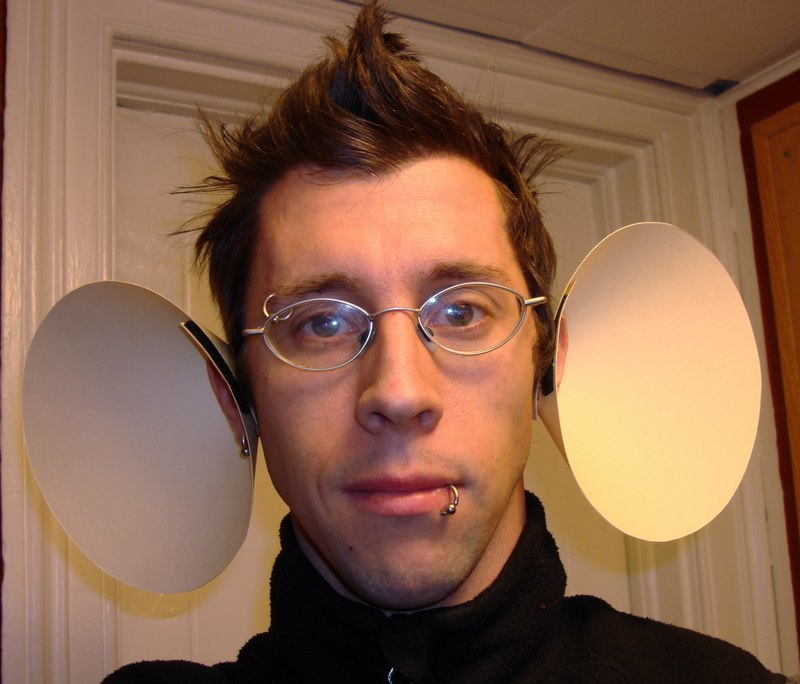
			<content:encoded><![CDATA[<p><a href="http://robertcarlsen.net/blog/wp-content/uploads/2009/02/big-ears-front.jpg" rel="lightbox[364]"><img class="alignright size-thumbnail wp-image-366" title="big-ears-front" src="http://robertcarlsen.net/blog/wp-content/uploads/2009/02/big-ears-front-150x150.jpg" alt="big-ears-front" width="150" height="150" /></a><em>megaphones for ears. inspired by prince, tigre and penguin</em>.</p>
<p>i&#8217;ve always been a cat person. when i lived with my first cat i&#8217;d watch his ears swivel as he would listen to the sounds around us. sometimes i&#8217;d make quiet noises when he was looking away to see if he&#8217;d turn his ears toward me.</p>
<p>it is easy, of course, to accomplish a shadow of his ability by cupping my hands behind my ears&#8230;but i wanted to try something much more foolish.<span id="more-364"></span></p>
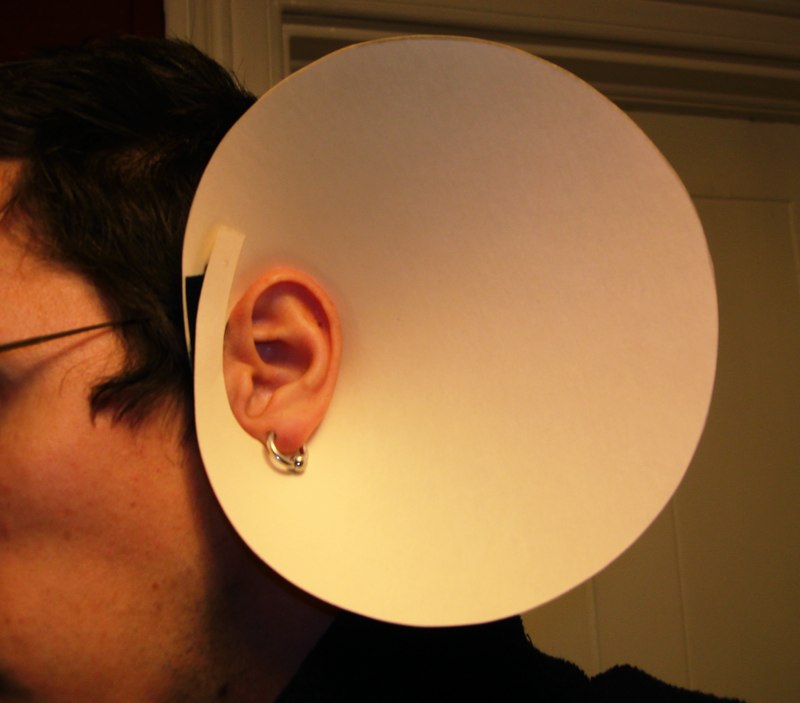
<p><a href="http://robertcarlsen.net/blog/wp-content/uploads/2009/02/big-ear-side.jpg" rel="lightbox[364]"><img class="alignleft size-thumbnail wp-image-365" style="margin-left: 2px; margin-right: 2px;" title="big-ear-side" src="http://robertcarlsen.net/blog/wp-content/uploads/2009/02/big-ear-side-150x150.jpg" alt="big-ear-side" width="150" height="150" /></a>enter the {h}ears. cardboard with hook and loop fasteners is curled around the ear into a horn, similar to an old phonograph or megaphone. they are light enough to stay put without being held while walking. hearing is (arguably) more directional while they are worn. this first prototype evokes more of a mouse ear than a cat ear, but there is always version two.</p>
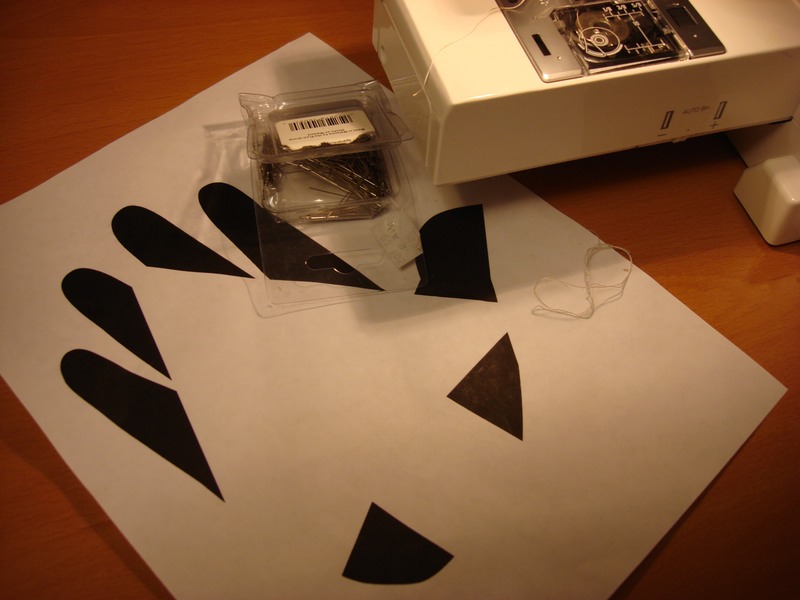
<p><a href="http://robertcarlsen.net/blog/wp-content/uploads/2009/02/drawing-board.jpg" rel="lightbox[364]"><img class="size-thumbnail wp-image-367 alignright" style="margin-left: 2px; margin-right: 2px;" title="drawing-board" src="http://robertcarlsen.net/blog/wp-content/uploads/2009/02/drawing-board-150x150.jpg" alt="drawing-board" width="150" height="150" /></a>back to the drawing board – literally. it was really nice to draft by hand for a change rather than start at the keyboard. i may be onto something <img src='http://robertcarlsen.net/blog/wp-includes/images/smilies/icon_smile.gif' alt=':)' class='wp-smiley' /> </p>
<p>here&#8217;s the <a href="http://robertcarlsen.net/blog/wp-content/uploads/2009/02/hears_template.pdf">template</a> for your own {h}ears.</p>
]]></content:encoded>
			<wfw:commentRss>http://robertcarlsen.net/2009/02/04/thinking-physically-hears-364/feed</wfw:commentRss>
		<slash:comments>3</slash:comments>
		</item>
		<item>
		<title>Thinking Physically: Experiment 1</title>
		<link>http://robertcarlsen.net/2009/01/28/thinking-physically-experiment-1-324</link>
		<comments>http://robertcarlsen.net/2009/01/28/thinking-physically-experiment-1-324#comments</comments>
		<pubDate>Wed, 28 Jan 2009 14:00:33 +0000</pubDate>
		<dc:creator>Robert</dc:creator>
				<category><![CDATA[Thinking Physically]]></category>
		<category><![CDATA[clothing]]></category>
		<category><![CDATA[design]]></category>
		<category><![CDATA[interaction]]></category>
		<category><![CDATA[itp]]></category>
		<category><![CDATA[make]]></category>
		<category><![CDATA[sewing]]></category>
		<category><![CDATA[think phys]]></category>
		<category><![CDATA[tshirt]]></category>

		<guid isPermaLink="false">http://robertcarlsen.net/blog/?p=324</guid>
		<description><![CDATA[Our first experiment for Thinking Physically is to &#8220;Create an interface or interaction that causes a person to &#8216;open up&#8217;.&#8221; This statement is intentionally vague – emotional, physical, literal?
My initial notes:
People seem to be aloof or wary of unfamiliar others. A shared experience seems to break down this distance. Observing a humorous or traumatic event. [...]]]></description>
			<content:encoded><![CDATA[<p>Our first experiment for Thinking Physically is to &#8220;Create an interface or interaction that causes a person to &#8216;open up&#8217;.&#8221; This statement is intentionally vague – emotional, physical, literal?</p>
<p>My initial notes:<br />
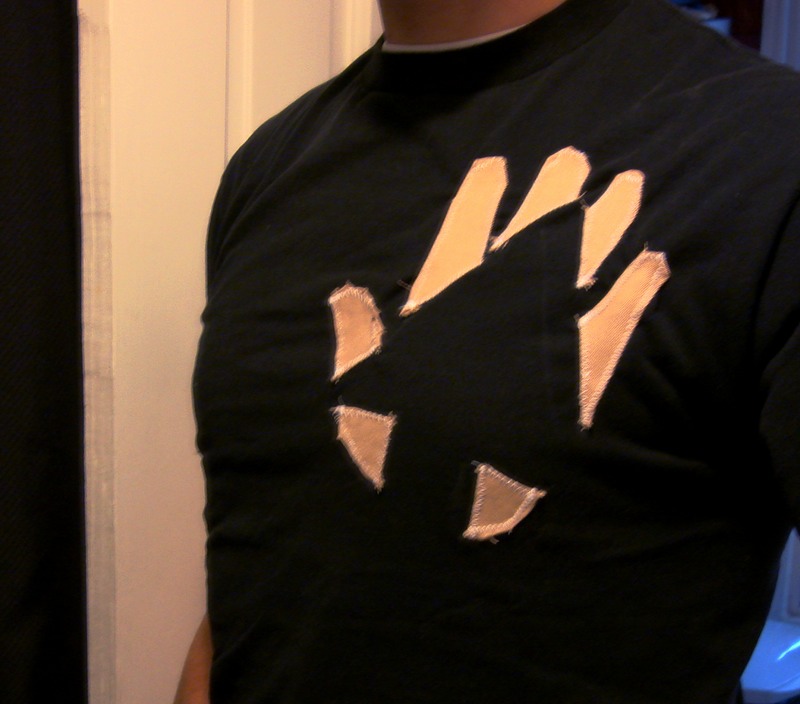
<a href="http://robertcarlsen.net/blog/wp-content/uploads/2009/01/hi5_template.jpg" rel="lightbox[324]"><img class="alignright size-medium wp-image-326" title="hi5_template" src="http://robertcarlsen.net/blog/wp-content/uploads/2009/01/hi5_template-300x225.jpg" alt="hi5_template" width="167" height="125" /></a>People seem to be aloof or wary of unfamiliar others. A shared experience seems to break down this distance. Observing a humorous or traumatic event. An emergency where people have to work together quickly. A spontaneous celebration. Whether it is a positive or a negative experience, a remarkable experience is what will break down barriers.</p>
<p>Apparel. A provocative piece of clothing will stimulate conversation. Affiliation though style, political or sports slogan can serve to both connect and to alienate others.<br />
Gadgets &#8211; a sighting of an iPhone, and first generation iPod before it would generate interest enough to overcome avoidance of strangers. Someone wearing headphones is interpreted as a signal that they want to be left alone.<br />
Gesture. Smiling might convey various messages given context&#8230;however they would still be different than a furrowed brow. Eyes &#8211; looking at someone vs. averting gaze. Culturally determined?</p>
<p>On another level, what about established relationships? I’ve been focusing on unfamiliar relationships between people – strangers, in a city perhaps. What about acquaintances, friends, co-workers, family, partners (an all the variant types here). What about opening up more in an established relationship? Would that be limited focused on emotion?</p>
<p><a href="http://robertcarlsen.net/blog/wp-content/uploads/2009/01/hi5_shirt.jpg" rel="lightbox[324]"><img class="alignleft size-medium wp-image-325" style="margin-left: 2px; margin-right: 2px;" title="hi5_shirt" src="http://robertcarlsen.net/blog/wp-content/uploads/2009/01/hi5_shirt-300x264.jpg" alt="hi5_shirt" width="148" height="130" /></a>After a quick message passing with Kate who gave me some great advice – don&#8217;t overthink it – I came up with a simple idea: &#8220;what about a &#8216;Hi 5&#8242; shirt? Something really graphically simple and aesthetic. without words, a simple gesture and the image should convey the intention.&#8221;</p>
<p>I&#8217;ll know if it works later today&#8230;</p>
]]></content:encoded>
			<wfw:commentRss>http://robertcarlsen.net/2009/01/28/thinking-physically-experiment-1-324/feed</wfw:commentRss>
		<slash:comments>4</slash:comments>
		</item>
		<item>
		<title>Toy Design: SkipDraw*</title>
		<link>http://robertcarlsen.net/2009/01/27/toy-design-skipdraw-313</link>
		<comments>http://robertcarlsen.net/2009/01/27/toy-design-skipdraw-313#comments</comments>
		<pubDate>Tue, 27 Jan 2009 18:08:53 +0000</pubDate>
		<dc:creator>Robert</dc:creator>
				<category><![CDATA[Toy Design]]></category>
		<category><![CDATA[group]]></category>
		<category><![CDATA[itp]]></category>
		<category><![CDATA[led]]></category>
		<category><![CDATA[make]]></category>
		<category><![CDATA[project]]></category>

		<guid isPermaLink="false">http://robertcarlsen.net/blog/?p=313</guid>
		<description><![CDATA[*(the name of the toy is still under consideration)

SkipDraw
A classic toy  reinvented for the active kid of today.
Wear the SkipDraw on your ankle and spin it on the floor around your feet.   As it spins, the LED lighted cross will rotate independently. See it draw images of light in mid air as [...]]]></description>
			<content:encoded><![CDATA[<h5>*(the name of the toy is still under consideration)</h5>
<h5><a href="http://robertcarlsen.net/blog/wp-content/uploads/2009/01/skipdraw_center.jpg" rel="lightbox[313]"><img class="alignright size-medium wp-image-314" style="margin-left: 2px; margin-right: 2px;" title="skipdraw_center" src="http://robertcarlsen.net/blog/wp-content/uploads/2009/01/skipdraw_center-300x241.jpg" alt="skipdraw_center" width="219" height="174" /></a></h5>
<p><strong>SkipDraw</strong><br />
A classic toy  reinvented for the active kid of today.</p>
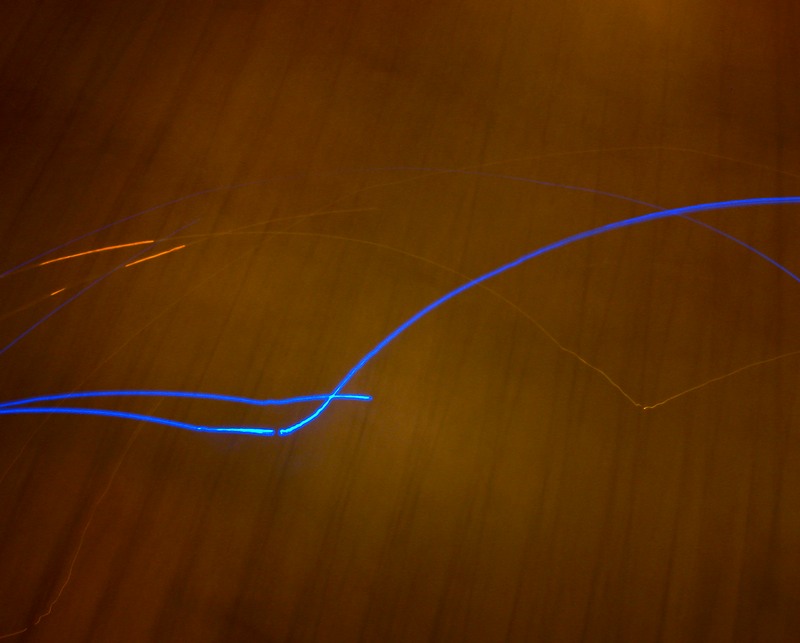
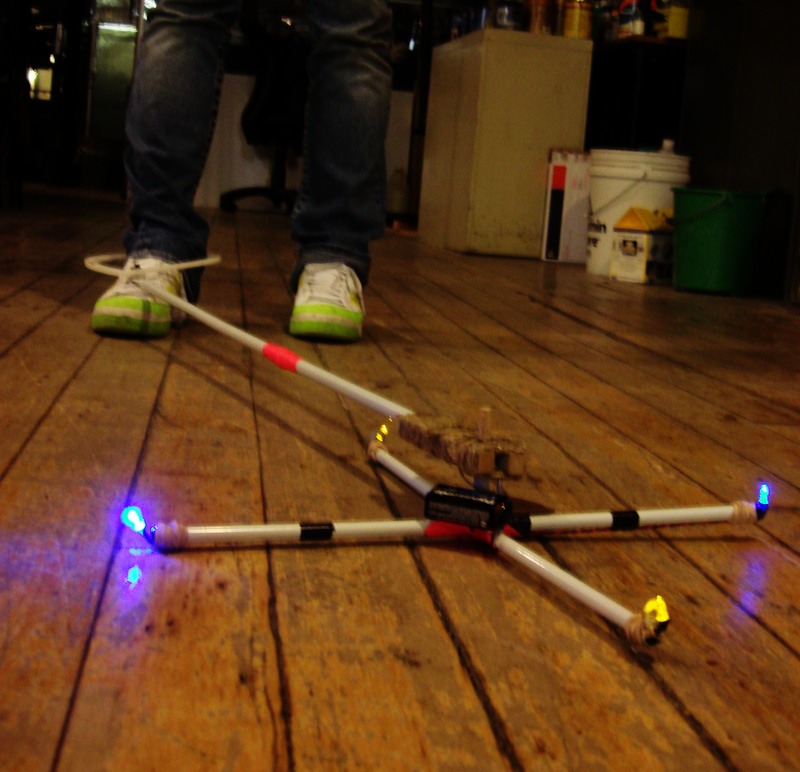
<p>Wear the SkipDraw on your ankle and spin it on the floor around your feet.   As it spins, the LED lighted cross will rotate independently. See it draw images of light in mid air as you skip in the center.</p>
<p><strong>Features:</strong></p>
<ul>
<li>Encourages kids to play outside of their rooms.</li>
<li>Promotes physical exercise.</li>
<li>Can be played indoors or outdoors.</li>
<li>Compact storage when not in use.</li>
<li>Is still engaging in daylight or without the batteries.</li>
<li>Entertaining to watch.</li>
</ul>
<p><span id="more-313"></span></p>
<p><a href="http://robertcarlsen.net/blog/wp-content/uploads/2009/01/skipdraw_overview.jpg" rel="lightbox[313]"><img class="alignleft size-medium wp-image-319" style="margin-left: 2px; margin-right: 2px;" title="skipdraw_overview" src="http://robertcarlsen.net/blog/wp-content/uploads/2009/01/skipdraw_overview-300x223.jpg" alt="skipdraw_overview" width="221" height="164" /></a>For our first Toy Design Workshop assignment, Marco, Paul, EJ and I were tasked with &#8220;designing a toy based on the concept of image creation&#8221;. This was a one-week development cycle, so there wasn&#8217;t much time for brainstorming and fabrication. After one quick meeting we generated four ideas: a pixel -based stamp drawing kit, a flashlight projector kit, wearable animal/monster feet &#8220;stamps&#8221;, and a spinning drawing toy – similar to the <a href="http://en.wikipedia.org/wiki/Skip-It" onclick="pageTracker._trackPageview('/outgoing/en.wikipedia.org/wiki/Skip-It?referer=');">SkipIt</a>. We set out to each research the feasibility of the ideas.</p>
<p>I&#8217;ve previously been interested in spiral and <a href="http://robertcarlsen.net/blog/?p=29">spirograph</a> drawing, so Paul&#8217;s idea to have a second spinning device on the end of the long axis of the spinning device intrigued me. A quick <a href="http://robertcarlsen.net/experiments/skipDraw/">animated sketch </a>helped with the <a href="http://robertcarlsen.net/blog/?p=308">pre-visualization</a>.</p>
<p><a href="http://robertcarlsen.net/blog/wp-content/uploads/2009/01/skipdraw_lapse.jpg" rel="lightbox[313]"><img class="alignright size-medium wp-image-316" style="margin-left: 2px; margin-right: 2px;" title="skipdraw_lapse" src="http://robertcarlsen.net/blog/wp-content/uploads/2009/01/skipdraw_lapse-300x225.jpg" alt="skipdraw_lapse" width="241" height="181" /></a>We met up again to discuss which idea to pursue and the spinning toy got the nod. We were still considering whether to make it a wearable, skipping toy or a smaller, hand-operated tabletop toy. I was more interested in the former, so I made a push to begin constructing that version of the device. We were still thinking about drawing with chalk, but haven&#8217;t figured out the delivery system for it. In the end we decided that we could get a working model to display the drawing pattern using LEDs and taking advantage of persistence-of-vision.</p>
<p>Eventually, using parts found on the junk shelf at ITP, some basic electronics and two hours we had a prototype to play with. It turns out to be quite fun, although it needs a bit of space to operate. Video below.</p>
<p><object width="425" height="344"><param name="movie" value="http://www.youtube.com/v/KF0Ta72ekQw&#038;fs=1" /><param name="allowFullScreen" value="true" /><param name="allowscriptaccess" value="always" /><embed src="http://www.youtube.com/v/KF0Ta72ekQw&#038;fs=1" type="application/x-shockwave-flash" allowscriptaccess="always" allowfullscreen="true" width="425" height="344"></embed></object></p>
<p><a href="http://robertcarlsen.net/blog/wp-content/uploads/2009/01/skipdraw_lit.jpg" rel="lightbox[313]"><img class="size-medium wp-image-318 alignnone" title="skipdraw_lit" src="http://robertcarlsen.net/blog/wp-content/uploads/2009/01/skipdraw_lit-300x289.jpg" alt="skipdraw_lit" width="300" height="289" /></a></p>
]]></content:encoded>
			<wfw:commentRss>http://robertcarlsen.net/2009/01/27/toy-design-skipdraw-313/feed</wfw:commentRss>
		<slash:comments>0</slash:comments>
		</item>
	</channel>
</rss>