<?xml version="1.0" encoding="UTF-8"?>
<rss version="2.0"
	xmlns:content="http://purl.org/rss/1.0/modules/content/"
	xmlns:wfw="http://wellformedweb.org/CommentAPI/"
	xmlns:dc="http://purl.org/dc/elements/1.1/"
	xmlns:atom="http://www.w3.org/2005/Atom"
	xmlns:sy="http://purl.org/rss/1.0/modules/syndication/"
	xmlns:slash="http://purl.org/rss/1.0/modules/slash/"
	>

<channel>
	<title>exploration &#187; photo</title>
	<atom:link href="http://robertcarlsen.net/tag/photo/feed" rel="self" type="application/rss+xml" />
	<link>http://robertcarlsen.net</link>
	<description>accounts of success and misadventure</description>
	<lastBuildDate>Tue, 13 Jul 2010 14:37:06 +0000</lastBuildDate>
	<generator>http://wordpress.org/?v=2.8.4</generator>
	<language>en</language>
	<sy:updatePeriod>hourly</sy:updatePeriod>
	<sy:updateFrequency>1</sy:updateFrequency>
			<item>
		<title>OCR for iPhone source</title>
		<link>http://robertcarlsen.net/2010/01/12/ocr-for-iphone-source-1080</link>
		<comments>http://robertcarlsen.net/2010/01/12/ocr-for-iphone-source-1080#comments</comments>
		<pubDate>Tue, 12 Jan 2010 06:46:58 +0000</pubDate>
		<dc:creator>Robert</dc:creator>
				<category><![CDATA[iphone]]></category>
		<category><![CDATA[camera]]></category>
		<category><![CDATA[git]]></category>
		<category><![CDATA[github]]></category>
		<category><![CDATA[ocr]]></category>
		<category><![CDATA[open source]]></category>
		<category><![CDATA[photo]]></category>
		<category><![CDATA[programming]]></category>
		<category><![CDATA[project]]></category>
		<category><![CDATA[xcode]]></category>

		<guid isPermaLink="false">http://robertcarlsen.net/?p=1080</guid>
		<description><![CDATA[The source code for the Tesseract OCR for iPhone project has been published. It&#8217;s really simple – more of a skeleton, proof-of-concept project than anything else. Still, though, it&#8217;s neat to have nearly point-and-shoot text conversion in your pocket.
The project page is: Pocket OCR
The source code is available at github: http://github.com/rcarlsen/Pocket-OCR
There is certainly a lot [...]]]></description>
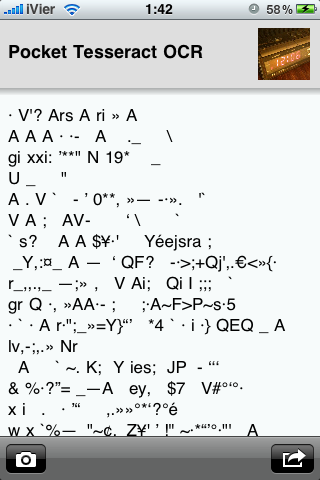
			<content:encoded><![CDATA[<p><a href="http://robertcarlsen.net/blog/wp-content/uploads/2010/01/ocr_gobbledygook.png" rel="lightbox[1080]"><img class="alignright size-thumbnail wp-image-1089" title="ocr_gobbledygook" src="http://robertcarlsen.net/blog/wp-content/uploads/2010/01/ocr_gobbledygook-150x150.png" alt="ocr_gobbledygook" width="150" height="150" /></a>The source code for the Tesseract OCR for iPhone project has been published. It&#8217;s really simple – more of a skeleton, proof-of-concept project than anything else. Still, though, it&#8217;s neat to have nearly point-and-shoot text conversion in your pocket.</p>
<p>The project page is: <a href="http://robertcarlsen.net/dev/pocket-ocr">Pocket OCR</a></p>
<p>The source code is available at github: <a href="http://github.com/rcarlsen/Pocket-OCR" onclick="pageTracker._trackPageview('/outgoing/github.com/rcarlsen/Pocket-OCR?referer=');">http://github.com/rcarlsen/Pocket-OCR</a></p>
<p>There is certainly a lot of improvement to be made. Automatic color correction. Page layout recognition. Perspective correction&#8230;the list could go on. The code is there, so&#8230;fork away!</p>
<p>(the thumbnail is a bit tongue-in-cheek&#8230;but honest. good conversion requires a good source image: well-lit, macro, focused and tightly cropped seems best)</p>
]]></content:encoded>
			<wfw:commentRss>http://robertcarlsen.net/2010/01/12/ocr-for-iphone-source-1080/feed</wfw:commentRss>
		<slash:comments>2</slash:comments>
		</item>
		<item>
		<title>M5 Bus : Mashup</title>
		<link>http://robertcarlsen.net/2008/12/02/m5-bus-mashup-238</link>
		<comments>http://robertcarlsen.net/2008/12/02/m5-bus-mashup-238#comments</comments>
		<pubDate>Tue, 02 Dec 2008 09:19:11 +0000</pubDate>
		<dc:creator>Robert Carlsen</dc:creator>
				<category><![CDATA[itp]]></category>
		<category><![CDATA[applications]]></category>
		<category><![CDATA[bus]]></category>
		<category><![CDATA[google maps]]></category>
		<category><![CDATA[gps]]></category>
		<category><![CDATA[java]]></category>
		<category><![CDATA[m5]]></category>
		<category><![CDATA[mashup]]></category>
		<category><![CDATA[nyc]]></category>
		<category><![CDATA[photo]]></category>
		<category><![CDATA[processing]]></category>
		<category><![CDATA[programming]]></category>
		<category><![CDATA[tweet]]></category>
		<category><![CDATA[twitter]]></category>

		<guid isPermaLink="false">http://robertcarlsen.net/blog/?p=238</guid>
		<description><![CDATA[I&#8217;ve wanted to try another geocode mashup since the Where We Were project I ran at Moore College. I recently picked up a GPS unit, which got me thinking about it anew.
For the M5 Bus trip assignment for our Applications class I worked up a mix of Twitter, GPS location, digital photos and Google Maps. [...]]]></description>
			<content:encoded><![CDATA[<p>I&#8217;ve wanted to try another geocode mashup since the Where We Were project I ran at Moore College. I recently picked up a GPS unit, which got me thinking about it anew.</p>
<p>For the M5 Bus trip assignment for our Applications class I worked up a mix of Twitter, GPS location, digital photos and Google Maps. I had previously synchronized the clocks for the camera, phone and TomTom GPS unit&#8230;and used these timestamps later to literally mash the Twitter XML and TomTom GPX files together with a custom Java application. Geocoding the photographs was done using the gpsdings java application.</p>
<p>Google Maps will display carefully formed KML (Keyhole Markup Language) files, which is nice because Google Earth can open the same file.</p>
<p>The project is available at <a href="http://robertcarlsen.net/m5">http://robertcarlsen.net/m5</a>. Although this entry is focused specifically on the technical side, I welcome comments here on the thoughts presented on the project page.</p>
]]></content:encoded>
			<wfw:commentRss>http://robertcarlsen.net/2008/12/02/m5-bus-mashup-238/feed</wfw:commentRss>
		<slash:comments>1</slash:comments>
		</item>
	</channel>
</rss>
