<?xml version="1.0" encoding="UTF-8"?>
<rss version="2.0"
	xmlns:content="http://purl.org/rss/1.0/modules/content/"
	xmlns:wfw="http://wellformedweb.org/CommentAPI/"
	xmlns:dc="http://purl.org/dc/elements/1.1/"
	xmlns:atom="http://www.w3.org/2005/Atom"
	xmlns:sy="http://purl.org/rss/1.0/modules/syndication/"
	xmlns:slash="http://purl.org/rss/1.0/modules/slash/"
	>

<channel>
	<title>exploration &#187; visualizing</title>
	<atom:link href="http://robertcarlsen.net/tag/visualizing/feed" rel="self" type="application/rss+xml" />
	<link>http://robertcarlsen.net</link>
	<description>accounts of success and misadventure</description>
	<lastBuildDate>Tue, 13 Jul 2010 14:37:06 +0000</lastBuildDate>
	<generator>http://wordpress.org/?v=2.8.4</generator>
	<language>en</language>
	<sy:updatePeriod>hourly</sy:updatePeriod>
	<sy:updateFrequency>1</sy:updateFrequency>
			<item>
		<title>Spatial Media: Kitchen Interface</title>
		<link>http://robertcarlsen.net/2009/01/28/spatial-media-kitchen-interface-329</link>
		<comments>http://robertcarlsen.net/2009/01/28/spatial-media-kitchen-interface-329#comments</comments>
		<pubDate>Thu, 29 Jan 2009 03:38:08 +0000</pubDate>
		<dc:creator>Robert</dc:creator>
				<category><![CDATA[Spatial Media]]></category>
		<category><![CDATA[design]]></category>
		<category><![CDATA[interaction]]></category>
		<category><![CDATA[interface]]></category>
		<category><![CDATA[itp]]></category>
		<category><![CDATA[kitchen]]></category>
		<category><![CDATA[stove]]></category>
		<category><![CDATA[visualizing]]></category>

		<guid isPermaLink="false">http://robertcarlsen.net/blog/?p=329</guid>
		<description><![CDATA[Spatial Media looks to be an interesting topic. One thing that I could really take away from Jared&#8217;s first presentation was:
&#8220;It’s about context in space. It’s about information &#8211; all information has a space. Conversely, all places have information.&#8221;
Assignment 1: The Kitchen
What is the context of a kitchen? How do people really use kitchens?
A quick [...]]]></description>
			<content:encoded><![CDATA[<p>Spatial Media looks to be an interesting topic. One thing that I could really take away from Jared&#8217;s first presentation was:</p>
<blockquote><p>&#8220;It’s about context in space. It’s about information &#8211; all information has a space. Conversely, all places have information.&#8221;</p></blockquote>
<p><strong>Assignment 1: </strong>The Kitchen<br />
What is the context of a kitchen? How do people really use kitchens?</p>
<p>A quick (hardly inclusive) list of kitchen based activities: Cooking, eating, cleaning. Socializing. Entertaining. Storing food &#8211; pantry / refrigerator.</p>
<p>Drilling down into just one activity, cooking, what could be involved in that task which could have an interface designed?<span id="more-329"></span></p>
<p><strong>Cooking tasks:</strong></p>
<ul>
<li>Gather ingredients.</li>
<li>Prepare ingredients.</li>
<li>Prepare tools &#8211; utensils, cookware.</li>
<li>Prepare cooking surface &#8211; preheat oven, grease pans, boil water, warm oil.</li>
<li>Cook &#8211; various methods: steam, sauté, stir fry, sear, boil, broil, bake, warm, poach, deep fry</li>
<li>Cook &#8211; manipulate: toss, stir, brown, scramble, blanche</li>
<li>Often tasks are interleaved and simultaneous. ie. cooking something while gathering or preparing another.</li>
<li>Presentation.</li>
<li>EAT! (not really part of cooking, exactly, but it&#8217;s a big reward for the effort).</li>
<li>clean.</li>
</ul>
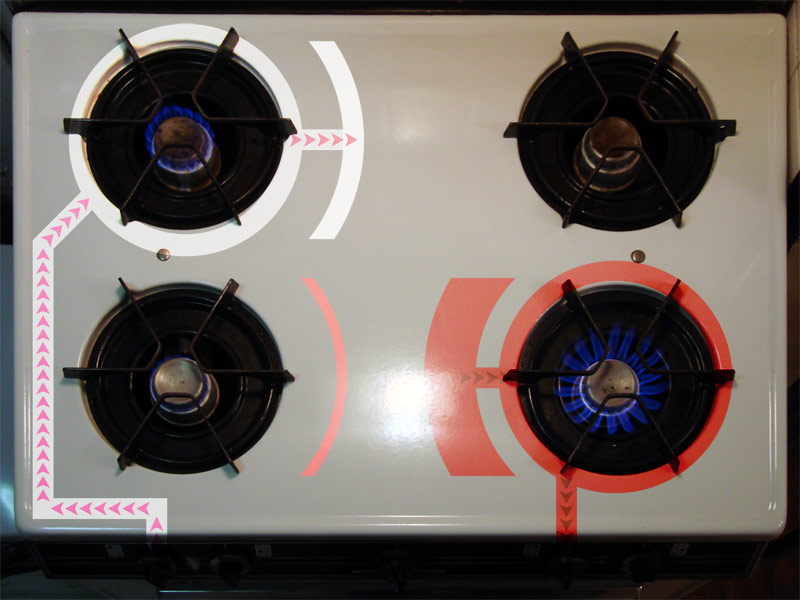
<p><a href="http://robertcarlsen.net/blog/wp-content/uploads/2009/01/range_demo_overlay_wide_flames.jpg" rel="lightbox[329]"><img class="alignright size-medium wp-image-336" title="range_demo_overlay_wide_flames" src="http://robertcarlsen.net/blog/wp-content/uploads/2009/01/range_demo_overlay_wide_flames-274x300.jpg" alt="range_demo_overlay_wide_flames" width="178" height="194" /></a>So, the act of cooking is quite complex. Maybe simplify, and just provide visual information about the stove. Gas ranges have a natural visual indication of their setting&#8230; larger flames indicate a hotter setting; you can hear the gas of the oven ignite when it’s warming. Electric coil ranges aren’t as expressive, although glowing red coils usually means it’s really hot. Sealed element electric ranges may glow differently. Many ranges have some kind of other visual cue to warn of a warm surface. Often these are lights distanced from the heating elements themselves and may suffer from poor mapping.</p>
<p>What information is relevant? Temperature / setting of the range and oven. Heating up / cooling down. Preheat ETA? Multiple cooking timers? Presence of cookware?<br />
Direct (natural) mapping is most important here. Whereas gas ranges indicate their heat setting visually as a by-product of the technology and electric ranges seem to indicate whether the surface is warm or not, in both cases the temperature of the cooking surface must be inferred. Hot oil will sizzle water &#8211; too hot will smoke. How warm is a low setting? If cooking instructions don’t indicate an explicit temperature requirement in objective units, is it necessary to display the specific temperature of the cooking surface? Should this be an entirely new proprietary system, or it is something that can be retrofit onto existing ranges?</p>
<p><strong><a href="http://robertcarlsen.net/blog/wp-content/uploads/2009/01/range-overlay-top-flames.jpg" rel="lightbox[329]"><img class="alignright size-medium wp-image-335" title="range-overlay-top-flames" src="http://robertcarlsen.net/blog/wp-content/uploads/2009/01/range-overlay-top-flames-300x225.jpg" alt="range-overlay-top-flames" width="199" height="149" /></a>Cooking surface temperature:</strong><br />
Use color? Blue -&gt; Red is a typical cool -&gt; hot mapping. Gas ranges typically have blue flame, though regardless of the temperature setting. Use saturation? White (cool) -&gt; Red (hot)?</p>
<p><strong>Burner setting:</strong><br />
If using color to indicate the current temperature of the range, perhaps the scale of a particular burner&#8217;s display could indicate the target setting. A small graphic would be a low setting with a larger graphic indicating a high setting</p>
<p><strong>Controls:</strong><br />
If retrofitting, perhaps there could be an indication of which control is mapped to which heating element. When an element is touched, display a connecting path to the controlled burner. If the heat is increased, display pulses along the path from the control to the burner “adding heat”; conversely display pulses from the burner to the control as it is reduced.</p>
<p><strong>Design notes:</strong><br />
All graphics related to a particular burner will share that burner’s current temperature color. Too many colors became distracting and confusing.</p>
<p><strong>Considerations:</strong><br />
Heat. Smoke. Steam (humidity). Splashes. Physical impact. Oil splatter. Dark range surface. Utensils on the range obscuring the display?</p>
<p><strong>Technology:</strong><br />
Projector, mounted above range, in range hood, should keep it away from most spills and splatters, however it would still be susceptible to heat, humidity and smoke.<br />
Temperature sensor(s). Physically mounted at each burner? Infrared / Laser temperature sensor(s) mounted in the range hood may permit sensing of the cooking surface rather then the heating element.<br />
Microcontroller to manage sensors.<br />
Multimedia computer to generate display</p>
<p><strong>Other considerations:</strong><br />
There seem to be several patents for various in-kitchen work surface projection displays.<br />
<a href="http://www.wikipatents.com/6334684.html" onclick="pageTracker._trackPageview('/outgoing/www.wikipatents.com/6334684.html?referer=');">Built-in kitchen having projector, and cooking assisting image projecting system &#8211; Patent Review 6334684</a><br />
<a href="http://www.wikipatents.com/6976004.html" onclick="pageTracker._trackPageview('/outgoing/www.wikipatents.com/6976004.html?referer=');">Interactive kitchen control system and method &#8211; Patent Review 6976004</a></p>
]]></content:encoded>
			<wfw:commentRss>http://robertcarlsen.net/2009/01/28/spatial-media-kitchen-interface-329/feed</wfw:commentRss>
		<slash:comments>0</slash:comments>
		</item>
		<item>
		<title>(Signal to) Noise meter, ITP 4in4, day 4</title>
		<link>http://robertcarlsen.net/2009/01/15/signal-to-noise-meter-itp-4in4-day-4-296</link>
		<comments>http://robertcarlsen.net/2009/01/15/signal-to-noise-meter-itp-4in4-day-4-296#comments</comments>
		<pubDate>Thu, 15 Jan 2009 20:15:27 +0000</pubDate>
		<dc:creator>Robert</dc:creator>
				<category><![CDATA[itp]]></category>
		<category><![CDATA[make]]></category>
		<category><![CDATA[4in4]]></category>
		<category><![CDATA[analog]]></category>
		<category><![CDATA[arduino]]></category>
		<category><![CDATA[fun]]></category>
		<category><![CDATA[hacking]]></category>
		<category><![CDATA[meter]]></category>
		<category><![CDATA[processing]]></category>
		<category><![CDATA[programming]]></category>
		<category><![CDATA[visualizing]]></category>

		<guid isPermaLink="false">http://robertcarlsen.net/blog/?p=296</guid>
		<description><![CDATA[For today&#8217;s project I wanted to do something with the analog decibel meter that Tymm gave me on day one. My idea is to calculate some kind of signal to noise ratio in my email inbox and to display the value on this physical meter. Since I already get a lot of noise in there, [...]]]></description>
			<content:encoded><![CDATA[<p>For today&#8217;s project I wanted to do something with the analog decibel meter that Tymm gave me on day one. My idea is to calculate some kind of signal to noise ratio in my email inbox and to display the value on this physical meter. Since I already get a lot of noise in there, maybe the value won&#8217;t change very dynamically, but be a steady din. Perhaps I could tie into the junk mail filter to show just how much work it&#8217;s doing, like a tachometer. Who am I kidding, really, I&#8217;m likely going to jump into what all the cool kids are doing and just come up with some type of Twitter visualization&#8230;  <span id="more-296"></span></p>
<p>Regardless of the data source, for the output side I&#8217;m driving the analog decibel meter with an Arduino using pulse width modulation (PWM). Inside it seems to be a small electromagnet whose field moves the needle to the right. The movement is counteracted by several springs which keep the needle trying to pull back to the left.</p>
<p>It seems to take minimal current &lt; 1mA at 5V to peg the needle. The face of the meter indicates &#8220;1mW 600 Ohm&#8221; which I assume means that the max input is 1mW and the resistance of the unit is 600Ohm. (Please correct me if I&#8217;m wrong). I&#8217;ve installed a 220Ohm resistor and small LED in series to provide more load to the PWM pin which allows finer steps in the meter as well as protects the Arduino from any possible reverse current as the needle&#8217;s springs pull it back past the electromagnet. I likely don&#8217;t need that, but it wouldn&#8217;t be an ITP project without an LED (it&#8217;s not blinking, though).</p>
<p>In this demo the Arduino is receiving data via a serial connection from a simple Processing sketch to control the position of the needle. In the above mentioned configuration I&#8217;m mapping the input value to a PWM output range of 0-40. Sending byte 255 will change modes in the program. The default mode is to accept ASCII values of 48-52 (that&#8217;s 0-9) so I can test in a terminal. The second mode will accept all bytes bytes of 0-254, and the third mode simply reports back the received values.</p>
<p>Next step is to figure out exactly what to do with the meter; since it accepts serial data it is pretty modular.</p>
<p><object width="425" height="344"><param name="movie" value="http://www.youtube.com/v/T_784yakuvc&#038;fs=1" /><param name="allowFullScreen" value="true" /><param name="allowscriptaccess" value="always" /><embed src="http://www.youtube.com/v/T_784yakuvc&#038;fs=1" type="application/x-shockwave-flash" allowscriptaccess="always" allowfullscreen="true" width="425" height="344"></embed></object></p>
]]></content:encoded>
			<wfw:commentRss>http://robertcarlsen.net/2009/01/15/signal-to-noise-meter-itp-4in4-day-4-296/feed</wfw:commentRss>
		<slash:comments>0</slash:comments>
		</item>
		<item>
		<title>Touch Fingerprint</title>
		<link>http://robertcarlsen.net/2008/12/17/touch-fingerprint-253</link>
		<comments>http://robertcarlsen.net/2008/12/17/touch-fingerprint-253#comments</comments>
		<pubDate>Thu, 18 Dec 2008 04:57:33 +0000</pubDate>
		<dc:creator>Robert Carlsen</dc:creator>
				<category><![CDATA[Uncategorized]]></category>
		<category><![CDATA[Visualizing the Five Senses]]></category>
		<category><![CDATA[itp]]></category>
		<category><![CDATA[eyes]]></category>
		<category><![CDATA[processing]]></category>
		<category><![CDATA[visualizing]]></category>

		<guid isPermaLink="false">http://robertcarlsen.net/blog/?p=253</guid>
		<description><![CDATA[An in-class exercise in trying to convey the sense of touch on-screen. Given a matrix of white points on a black field, we had to rework the project with our own &#8220;fingerprint&#8221; in about 30 minutes.
Applet and code

]]></description>
			<content:encoded><![CDATA[<p>An in-class exercise in trying to convey the sense of touch on-screen. Given a matrix of white points on a black field, we had to rework the project with our own &#8220;fingerprint&#8221; in about 30 minutes.<span id="more-253"></span></p>
<p><a href="http://www.robertcarlsen.net/media/itp/vis5/touchFingerprint/" onclick="pageTracker._trackPageview('/outgoing/www.robertcarlsen.net/media/itp/vis5/touchFingerprint/?referer=');">Applet and code</a></p>
<p><a href="http://robertcarlsen.net/blog/wp-content/uploads/2008/12/eyes-touch.jpg" rel="lightbox[253]"><img class="alignnone size-medium wp-image-254" title="eyes-touch" src="http://robertcarlsen.net/blog/wp-content/uploads/2008/12/eyes-touch-300x214.jpg" alt="" width="383" height="273" /></a></p>
]]></content:encoded>
			<wfw:commentRss>http://robertcarlsen.net/2008/12/17/touch-fingerprint-253/feed</wfw:commentRss>
		<slash:comments>0</slash:comments>
		</item>
		<item>
		<title>Visualizing (proxemic) space</title>
		<link>http://robertcarlsen.net/2008/12/17/visualizing-proxemic-space-248</link>
		<comments>http://robertcarlsen.net/2008/12/17/visualizing-proxemic-space-248#comments</comments>
		<pubDate>Thu, 18 Dec 2008 04:27:20 +0000</pubDate>
		<dc:creator>Robert Carlsen</dc:creator>
				<category><![CDATA[Uncategorized]]></category>
		<category><![CDATA[Visualizing the Five Senses]]></category>
		<category><![CDATA[itp]]></category>
		<category><![CDATA[cycling]]></category>
		<category><![CDATA[nyc]]></category>
		<category><![CDATA[processing]]></category>
		<category><![CDATA[proxemics]]></category>
		<category><![CDATA[visualization]]></category>
		<category><![CDATA[visualizing]]></category>

		<guid isPermaLink="false">http://robertcarlsen.net/blog/?p=248</guid>
		<description><![CDATA[In conducting research for the CycleSense bicycle traffic proximity system I gathered data about the amount of space behind a bicycle rider traveling through typical New York City traffic at various times and locations. The initial visualization of this data was to graph the distances over time to look for specific events that the system [...]]]></description>
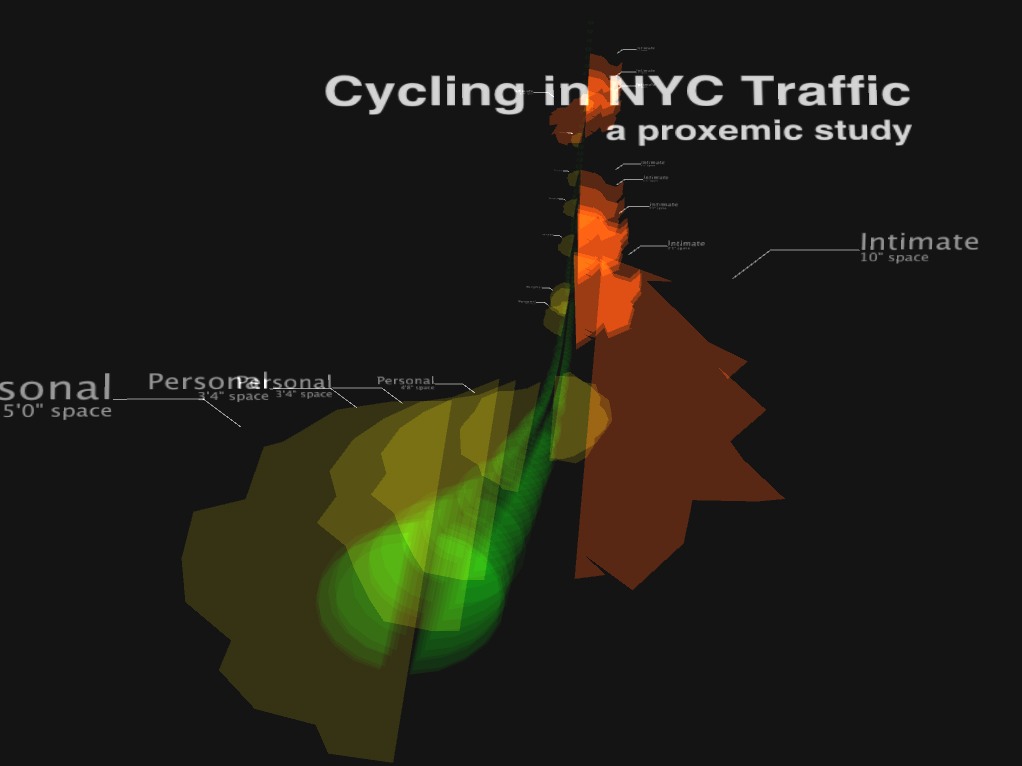
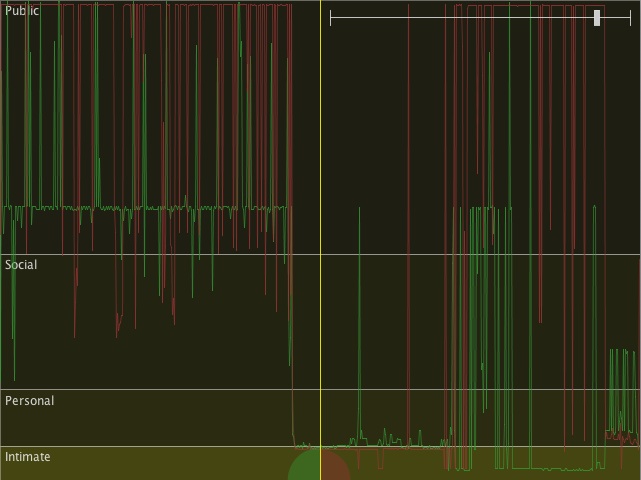
			<content:encoded><![CDATA[<p>In conducting research for the CycleSense bicycle traffic proximity system I gathered data about the amount of space behind a bicycle rider traveling through typical New York City traffic at various times and locations. The initial visualization of this data was to graph the distances over time to look for specific events that the system would need to detect in order to be useful. I cross-referenced the space data with video taken on the same rides</p>
<p><a href="http://robertcarlsen.net/blog/wp-content/uploads/2008/12/cycling-proxemic1.jpg" rel="lightbox[248]"><img class="alignnone size-medium wp-image-250" title="cycling-01" src="http://robertcarlsen.net/blog/wp-content/uploads/2008/12/cycling-proxemic1.jpg" alt="" width="442" height="329" /></a></p>
<p><span id="more-248"></span></p>
<p>While the <a href="http://robertcarlsen.net/blog/?p=232">graphing application</a> was certainly useful in tuning the system, it was confusing for viewers to understand. I don&#8217;t really view this as a fault of the design since it was intended to fulfill a specific need in developing the project. However, I really would like to convey the moments of traffic&#8217;s encroachment into a cyclist&#8217;s personal space.</p>
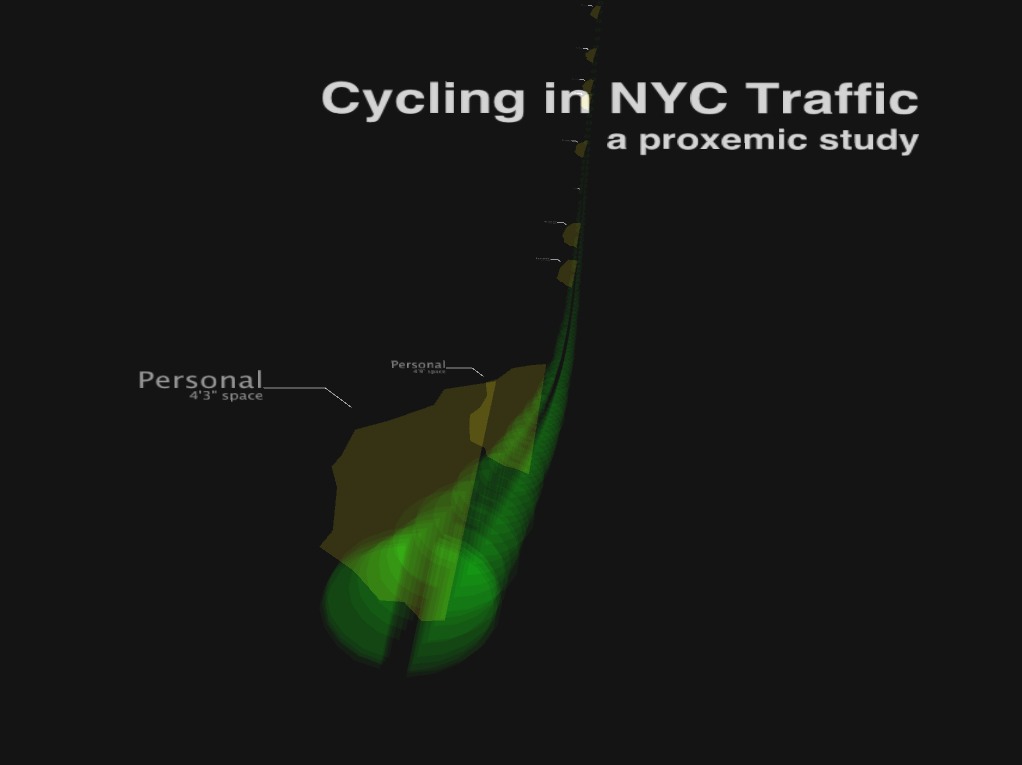
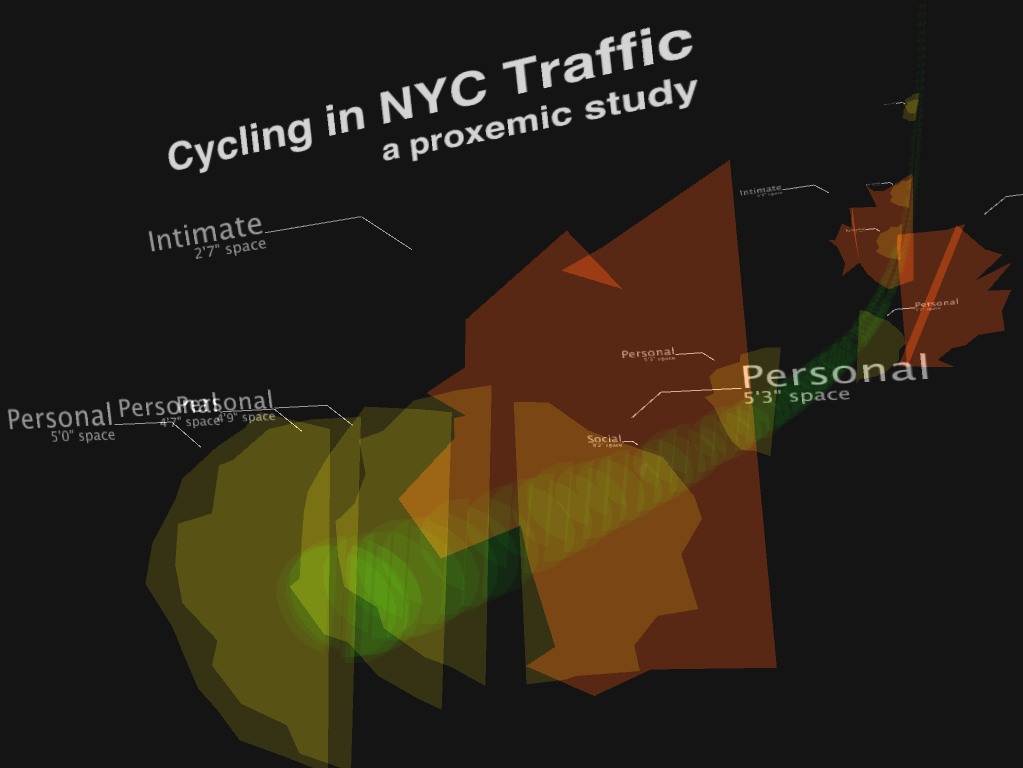
<p>I was directed to look into the field of proxemics and the work of Edward Hall by our &#8220;Visualizing the Five Senses&#8221; professor, Jane Nisselson (<a href="http://www.vbnyc.com/" onclick="pageTracker._trackPageview('/outgoing/www.vbnyc.com/?referer=');">Virtual Beauty</a>). What interested me most was the depiction of personal space into four categories: Intimate, Personal, Social and Public. Although this work primarily seems to deal with intrapersonal relationships I wondered if the categories could be used to express the space around a cyclist&#8230;specifically to communicate the space to non-cyclists.</p>
<p>Here are several images of the resulting visualization. The project is animated &#8211; I&#8217;ll an example of the movement online in the next few days, with the source code.</p>
<p><a href="http://robertcarlsen.net/blog/wp-content/uploads/2008/12/cycling-proxemic2.jpg" rel="lightbox[248]"><img class="alignnone size-medium wp-image-249" title="cycling-02" src="http://robertcarlsen.net/blog/wp-content/uploads/2008/12/cycling-proxemic2.jpg" alt="" width="450" height="336" /></a></p>
<p><a href="http://robertcarlsen.net/blog/wp-content/uploads/2008/12/cycling-proxemic3.jpg" rel="lightbox[248]"><img class="alignnone size-medium wp-image-252" title="cycling-03" src="http://robertcarlsen.net/blog/wp-content/uploads/2008/12/cycling-proxemic3.jpg" alt="" width="449" height="336" /></a></p>
]]></content:encoded>
			<wfw:commentRss>http://robertcarlsen.net/2008/12/17/visualizing-proxemic-space-248/feed</wfw:commentRss>
		<slash:comments>0</slash:comments>
		</item>
		<item>
		<title>space</title>
		<link>http://robertcarlsen.net/2008/11/25/space-232</link>
		<comments>http://robertcarlsen.net/2008/11/25/space-232#comments</comments>
		<pubDate>Tue, 25 Nov 2008 06:38:24 +0000</pubDate>
		<dc:creator>Robert Carlsen</dc:creator>
				<category><![CDATA[Intro to Physical Computing]]></category>
		<category><![CDATA[Visualizing the Five Senses]]></category>
		<category><![CDATA[itp]]></category>
		<category><![CDATA[edward hall]]></category>
		<category><![CDATA[pcom]]></category>
		<category><![CDATA[proxemics]]></category>
		<category><![CDATA[visualization]]></category>
		<category><![CDATA[visualizing]]></category>

		<guid isPermaLink="false">http://robertcarlsen.net/blog/?p=232</guid>
		<description><![CDATA[In reaction to seeing my research on the cycling proximity project Jane sent me some really interesting information about Edward Hall and his work on Proxemics. I&#8217;m still reading up on the concept, but in brief it pertains to the study of space that individuals maintain in various social interactions and specifically how several cultures [...]]]></description>
			<content:encoded><![CDATA[<p>In reaction to seeing my research on the cycling proximity project Jane sent me some really interesting information about Edward Hall and his work on Proxemics. I&#8217;m still reading up on the concept, but in brief it pertains to the study of space that individuals maintain in various social interactions and specifically how several cultures maintain different norms.</p>
<p>Here is an update to the proximity visualization application incorporating the 4 Proxemic distance classifications of Intimate, Personal, Social and Public. I&#8217;m hoping to show that while riding a bicycle in traffic riders experience frequent intrusions by vehicles into the Personal space. The haptic feedback device that is being devised for the CycleSense project will transpose the events in Social and Personal space to the Intimate space to provide an immediate awareness of these intrusions that generally go unseen as they occur behind the rider.</p>
<p>The next HUGE challenge is to refine the rangefinder sensor package, which I&#8217;ve never been able to get completely reliable.</p>
<p><a href="http://robertcarlsen.net/blog/wp-content/uploads/2008/11/cycling-proxemics-1.jpg" rel="lightbox[232]"><img class="alignnone size-medium wp-image-233" style="border: 1px solid black; margin: 3px;" title="cycling-proxemics-1" src="http://robertcarlsen.net/blog/wp-content/uploads/2008/11/cycling-proxemics-1-300x225.jpg" alt="" width="300" height="225" /></a><a href="http://robertcarlsen.net/blog/wp-content/uploads/2008/11/cycling-proxemics-2.jpg" rel="lightbox[232]"><img class="alignnone size-medium wp-image-234" style="border: 1px solid black; margin: 3px;" title="cycling-proxemics-2" src="http://robertcarlsen.net/blog/wp-content/uploads/2008/11/cycling-proxemics-2-300x224.jpg" alt="" width="300" height="224" /></a></p>
]]></content:encoded>
			<wfw:commentRss>http://robertcarlsen.net/2008/11/25/space-232/feed</wfw:commentRss>
		<slash:comments>1</slash:comments>
		</item>
		<item>
		<title>sense-o-llage</title>
		<link>http://robertcarlsen.net/2008/11/18/sense-o-llage-226</link>
		<comments>http://robertcarlsen.net/2008/11/18/sense-o-llage-226#comments</comments>
		<pubDate>Tue, 18 Nov 2008 06:24:39 +0000</pubDate>
		<dc:creator>Robert Carlsen</dc:creator>
				<category><![CDATA[Visualizing the Five Senses]]></category>
		<category><![CDATA[itp]]></category>
		<category><![CDATA[collage]]></category>
		<category><![CDATA[senses]]></category>
		<category><![CDATA[visualizing]]></category>

		<guid isPermaLink="false">http://robertcarlsen.net/blog/?p=226</guid>
		<description><![CDATA[combining the various sense visualizations into a collage. each layer is taken from a separate project. the overall guiding comment in this arrangement is that sound envelops and vision centers my awareness

looking forward to the final project for visualizing senses, i&#8217;m thinking of working with touch and space. several projects that i&#8217;ve investigated for other [...]]]></description>
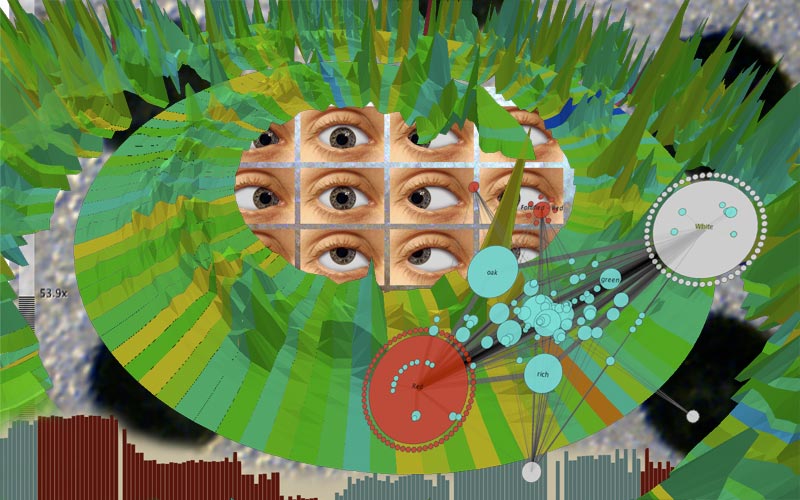
			<content:encoded><![CDATA[<p>combining the various sense visualizations into a collage. each layer is taken from a separate project. the overall guiding comment in this arrangement is that sound envelops and vision centers my awareness</p>
<p><a href="http://robertcarlsen.net/blog/wp-content/uploads/2008/11/senses_collage_800.jpg" rel="lightbox[226]"><img class="aligncenter size-medium wp-image-227" title="senses_collage_800" src="http://robertcarlsen.net/blog/wp-content/uploads/2008/11/senses_collage_800-300x187.jpg" alt="" width="300" height="187" /></a></p>
<p>looking forward to the final project for visualizing senses, i&#8217;m thinking of working with touch and space. several projects that i&#8217;ve investigated for other classes have involved interaction with proximity and awareness. what specifically drives the tactile sense? does the chill of a breeze or the warmth of nearby body stimulate similar senses as physical contact? at jane&#8217;s suggestion i&#8217;d like to read up on the field of proxemics as introduced by edward hall &#8211; the categorization of physical proximity and interactions deemed appropriate for each category. all this space around us&#8230;</p>
]]></content:encoded>
			<wfw:commentRss>http://robertcarlsen.net/2008/11/18/sense-o-llage-226/feed</wfw:commentRss>
		<slash:comments>0</slash:comments>
		</item>
		<item>
		<title>historic (visualizations)</title>
		<link>http://robertcarlsen.net/2008/11/04/historic-visualizations-209</link>
		<comments>http://robertcarlsen.net/2008/11/04/historic-visualizations-209#comments</comments>
		<pubDate>Wed, 05 Nov 2008 04:39:16 +0000</pubDate>
		<dc:creator>Robert Carlsen</dc:creator>
				<category><![CDATA[Uncategorized]]></category>
		<category><![CDATA[2008]]></category>
		<category><![CDATA[election]]></category>
		<category><![CDATA[mccain]]></category>
		<category><![CDATA[obama]]></category>
		<category><![CDATA[visualizing]]></category>

		<guid isPermaLink="false">http://robertcarlsen.net/blog/?p=209</guid>
		<description><![CDATA[wow. what a night. exhausted but filled with hope.
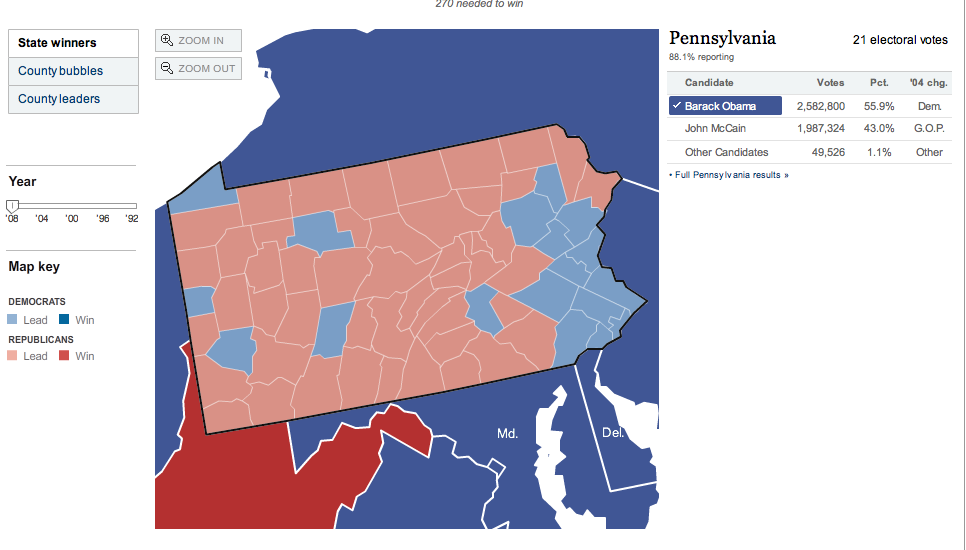
the visualizations of the results as they filtered in were great, but the new york times seemed best. specifically that you could zoom in and also look at historical results by state or county. great work

]]></description>
			<content:encoded><![CDATA[<p>wow. what a night. exhausted but filled with hope.</p>
<p>the visualizations of the results as they filtered in were great, but the new york times seemed best. specifically that you could zoom in and also look at historical results by state or county. great work</p>
<p><a href="http://robertcarlsen.net/blog/wp-content/uploads/2008/11/picture-1.png" rel="lightbox[209]"><img class="alignnone size-medium wp-image-207" title="picture-1" src="http://robertcarlsen.net/blog/wp-content/uploads/2008/11/picture-1-300x201.png" alt="" width="300" height="201" /></a><a href="http://robertcarlsen.net/blog/wp-content/uploads/2008/11/picture-2.png" rel="lightbox[209]"><img class="alignnone size-medium wp-image-208" title="picture-2" src="http://robertcarlsen.net/blog/wp-content/uploads/2008/11/picture-2-300x170.png" alt="" width="300" height="170" /></a></p>
]]></content:encoded>
			<wfw:commentRss>http://robertcarlsen.net/2008/11/04/historic-visualizations-209/feed</wfw:commentRss>
		<slash:comments>0</slash:comments>
		</item>
		<item>
		<title>Wine tasting</title>
		<link>http://robertcarlsen.net/2008/11/04/wine-tasting-202</link>
		<comments>http://robertcarlsen.net/2008/11/04/wine-tasting-202#comments</comments>
		<pubDate>Tue, 04 Nov 2008 05:33:15 +0000</pubDate>
		<dc:creator>Robert Carlsen</dc:creator>
				<category><![CDATA[Visualizing the Five Senses]]></category>
		<category><![CDATA[itp]]></category>
		<category><![CDATA[processing]]></category>
		<category><![CDATA[programming]]></category>
		<category><![CDATA[visualizing]]></category>

		<guid isPermaLink="false">http://robertcarlsen.net/blog/?p=202</guid>
		<description><![CDATA[Working with a large database of wines for the next Visualizing the Five Senses project. The database contains much information on approximately 5000 wines. After much thought on the sense of taste and after reading up on wine varieties, I decided to focus on the six categories of wine (Red, White, Sparkling-Red, Sparkling-White,  Fortified-Red [...]]]></description>
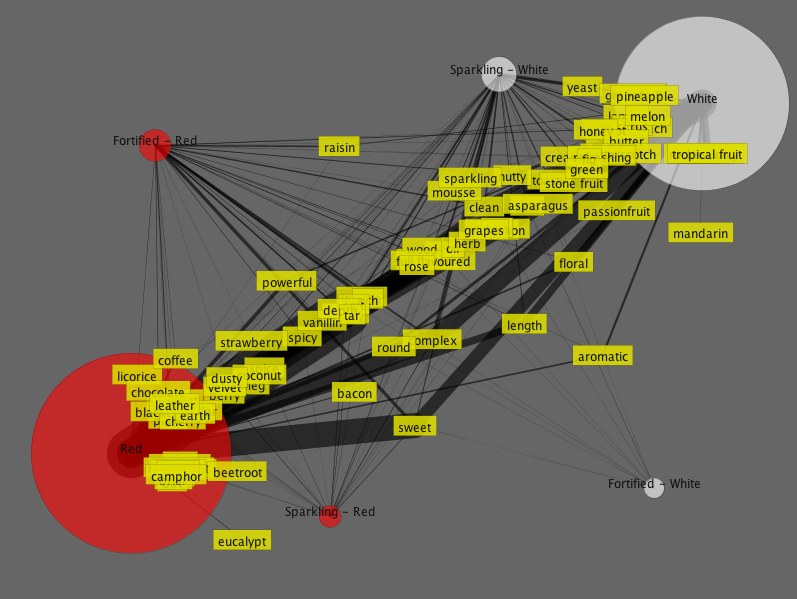
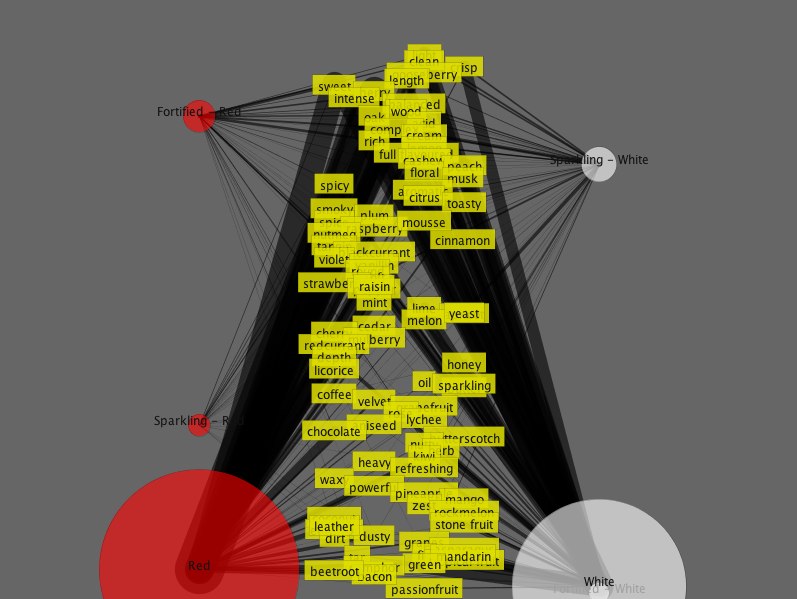
			<content:encoded><![CDATA[<p>Working with a large database of wines for the next Visualizing the Five Senses project. The database contains much information on approximately 5000 wines. After much thought on the sense of taste and after reading up on wine varieties, I decided to focus on the six categories of wine (Red, White, Sparkling-Red, Sparkling-White,  Fortified-Red and Fortified-White), and several oft-repeated taste characteristics noted in the wine descriptions.</p>
<p><a href="http://robertcarlsen.net/blog/wp-content/uploads/2008/11/wines-2.jpg" rel="lightbox[202]"><img class="alignnone size-medium wp-image-204" title="wines-2" src="http://robertcarlsen.net/blog/wp-content/uploads/2008/11/wines-2-300x225.jpg" alt="" width="300" height="225" /></a></p>
<p>This is very much a work in progress. <span id="more-202"></span>My ultimate goal with this visualization was to see if various varieties of wine share characteristics with other varieties of the same category.</p>
<p>The categories and taste characteristics are depicted in a network graph, and suffer from congestion due to the number of visible items. I&#8217;d really like to refine the display to isolate specific characteristics and/or wine varieties to clarify the visualization.</p>
<p><a href="http://robertcarlsen.net/blog/wp-content/uploads/2008/11/wines-1.jpg" rel="lightbox[202]"><img class="alignnone size-medium wp-image-203" title="wines-1" src="http://robertcarlsen.net/blog/wp-content/uploads/2008/11/wines-1-300x225.jpg" alt="" width="300" height="225" /></a></p>
<p>The above image depicts an early state of the animation. The tastes begin in a centralized location and drift toward the various categories, eventually settling along an axis determined by the &#8220;strength&#8221; that a particular taste shares with the wine as inferred by the frequency of those taste terms found in the wine database taste notes.</p>
<p>Unfortunately, I&#8217;m unable to post the live applet at the moment as the database is in MySQL format and I have yet to publish the database online. Here is a video of the preliminary interaction. The movement of the category ellipses are from user interaction.</p>
<p><img src="http://robertcarlsen.net/blog/wp-content/plugins/flash-video-player/default_video_player.gif" /></p>
]]></content:encoded>
			<wfw:commentRss>http://robertcarlsen.net/2008/11/04/wine-tasting-202/feed</wfw:commentRss>
		<slash:comments>2</slash:comments>
		</item>
		<item>
		<title>Scatterplot&#8230;</title>
		<link>http://robertcarlsen.net/2008/10/09/scatterplot-188</link>
		<comments>http://robertcarlsen.net/2008/10/09/scatterplot-188#comments</comments>
		<pubDate>Fri, 10 Oct 2008 03:56:48 +0000</pubDate>
		<dc:creator>Robert Carlsen</dc:creator>
				<category><![CDATA[Uncategorized]]></category>
		<category><![CDATA[Visualizing the Five Senses]]></category>
		<category><![CDATA[itp]]></category>
		<category><![CDATA[eclipse]]></category>
		<category><![CDATA[java]]></category>
		<category><![CDATA[processing]]></category>
		<category><![CDATA[visualizing]]></category>

		<guid isPermaLink="false">http://robertcarlsen.net/blog/?p=188</guid>
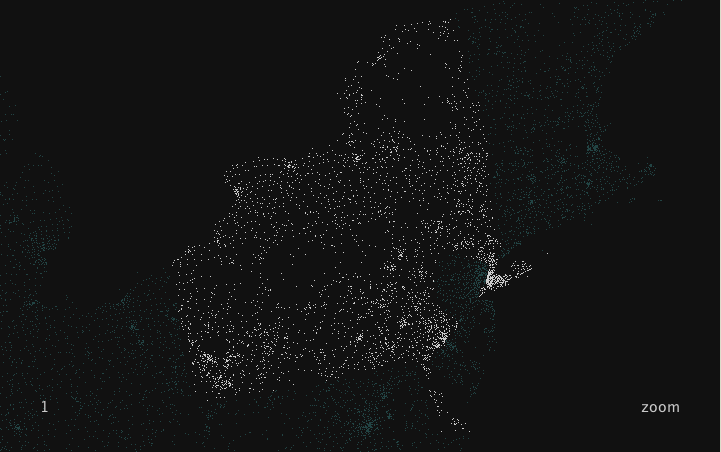
		<description><![CDATA[Trying to migrate my knowledge of Processing into Java and the Eclipse development environment. This is Ben Fry&#8217;s zipcode lookup applet as described in &#8220;Visualizing Data&#8221;. There are some oddities in my implementation of it, perhaps due to my inexperience with vanilla Java and a shoddy porting of his code.
Oh well, I&#8217;ll tinker with it [...]]]></description>
			<content:encoded><![CDATA[<p>Trying to migrate my knowledge of Processing into Java and the Eclipse development environment. This is Ben Fry&#8217;s zipcode lookup applet as described in &#8220;Visualizing Data&#8221;. There are some oddities in my implementation of it, perhaps due to my inexperience with vanilla Java and a shoddy porting of his code.</p>
<p>Oh well, I&#8217;ll tinker with it later.</p>
<p><a href="http://robertcarlsen.net/blog/wp-content/uploads/2008/10/picture-2.png" rel="lightbox[188]"><img class="alignnone size-medium wp-image-189" title="New York zip codes" src="http://robertcarlsen.net/blog/wp-content/uploads/2008/10/picture-2-300x188.png" alt="" width="300" height="188" /></a></p>
<p><a href="http://robertcarlsen.net/experiments/visualizing/scatterplot/">Applet and code</a></p>
]]></content:encoded>
			<wfw:commentRss>http://robertcarlsen.net/2008/10/09/scatterplot-188/feed</wfw:commentRss>
		<slash:comments>0</slash:comments>
		</item>
		<item>
		<title>Ripples</title>
		<link>http://robertcarlsen.net/2008/10/07/ripples-179</link>
		<comments>http://robertcarlsen.net/2008/10/07/ripples-179#comments</comments>
		<pubDate>Tue, 07 Oct 2008 05:25:31 +0000</pubDate>
		<dc:creator>Robert Carlsen</dc:creator>
				<category><![CDATA[Visualizing the Five Senses]]></category>
		<category><![CDATA[itp]]></category>
		<category><![CDATA[flight404]]></category>
		<category><![CDATA[processing]]></category>
		<category><![CDATA[visualizing]]></category>

		<guid isPermaLink="false">http://robertcarlsen.net/blog/?p=179</guid>
		<description><![CDATA[So, flight404&#8217;s (robert hodgin) work as been very inspiring and influential to my own. There are many people whom I feel are pushing the envelope of meaningful and beautiful visualization and he is one of them.

The Ripples project is one the the first that really convinced me to dive into using Processing. This depicts sound [...]]]></description>
			<content:encoded><![CDATA[<p>So, flight404&#8217;s (robert hodgin) work as been very inspiring and influential to my own. There are many people whom I feel are pushing the envelope of meaningful and beautiful visualization and he is one of them.</p>
<p><a href="http://www.flight404.com/version8/" onclick="pageTracker._trackPageview('/outgoing/www.flight404.com/version8/?referer=');"><img class="alignnone size-medium wp-image-180" title="ripples" src="http://robertcarlsen.net/blog/wp-content/uploads/2008/10/ripples-300x220.jpg" alt="" width="300" height="220" /></a></p>
<p>The Ripples project is one the the first that really convinced me to dive into using Processing. This depicts sound as a series of ripples emanating from the center of the display. Several example videos on the flight404 site show it being used as a VJ visualization. There have been many following projects, but this one really got me thinking about generative animation and the power of Classes. It&#8217;s relatively simple, too&#8230;so reading the code helps to inform new ideas.</p>
]]></content:encoded>
			<wfw:commentRss>http://robertcarlsen.net/2008/10/07/ripples-179/feed</wfw:commentRss>
		<slash:comments>0</slash:comments>
		</item>
	</channel>
</rss>